
Decagon built one of the most talked-about autonomous support platforms in the market. Founded in 2023 by Jesse Zhang and Ashwin Sreenivas, it deploys AI concierge agents that resolve issues end-to-end across chat, email, and voice, and its signature Agent Operating Procedures let non-technical managers describe complex workflows in plain language.
Verified user reviews on G2 rate it highly, around 4.9 out of 5, praising its autonomous performance and hands-on onboarding. Its customer roster includes Notion and Duolingo, as well as Chime and Rippling.
Even with that momentum, plenty of teams keep a shortlist of alternatives. Decagon does not publish pricing, and reviewers note that quote-only, enterprise-sized contracts make value hard to forecast early, especially with usage-based billing during volume spikes.
As a young product, some areas, such as user roles and audit logs, are still maturing. And for gaming studios, none of Decagon’s design choices are built around players, live-service events, or in-game support.
If Gartner expects agentic AI to autonomously resolve 80% of common customer service issues by 2029, it’s wise to choose an agent tuned to your actual workflows. This guide covers the seven best Decagon alternatives for 2026, ordered by use case fit, what each one is, where it stands out, where it fits best, and who should choose it.
What Decagon AI is and why teams explore alternatives
Decagon is an enterprise AI platform for customer support automation. Its agents connect to internal APIs and systems to verify accounts, process requests, and resolve issues end-to-end. Plus, its Watchtower feature adds always-on quality monitoring. That is a genuinely strong package, and it is why Decagon is on almost every enterprise shortlist.
However, the points below are fit considerations that send some buyers looking for Decagon alternatives in 2026:
1. Pricing is quote-only and enterprise-sized
Decagon does not publish rates. Reviewers and third-party analyses describe a platform fee plus usage, with annual commitments that commonly run well into six figures, putting it out of reach for smaller teams. Because usage is billed per conversation or per resolution, buyers who want to model spend against volume should also pin down exactly how a resolution is defined before signing.
2. Behavior under sudden traffic spikes
Some G2 reviewers and independent reports note slower responses and higher escalation during sudden surges in ticket volume, more so than during sustained high volume. For gaming studios, whose volume spikes hard around launches and limited-time events, peak-load behavior is worth scoping directly during evaluation.
3. Product maturity in some areas
As a fast-growing 2023 product, reviewers note that user roles and permissions remain basic and audit logs are limited, which matters most for regulated teams that need granular access control and deep traceability. Reviewers also note a clear roadmap addressing these issues.
4. No gaming specialization
Decagon serves the fintech, retail, travel, and software sectors. While its roster includes a gaming name, it does not offer a native in-game SDK, and player-specific journeys like ban appeals, entitlement sync, missing rewards, and account recovery are not first-class workflows. Gaming studios usually treat that as a disadvantage.
Decagon alternatives at a glance
Among the 2026 Decagon alternatives, Helpshift leads the table because it is the only option purpose-built for gaming. The rest are ordered by use-case fit:
| Platform | Best for | Starting price | Where it stands out |
|---|---|---|---|
| Helpshift | Gaming studios and player-driven apps | Custom (per-issue) | Native in-game SDK plus Care AI built for player workflows |
| Sierra | General enterprise CX | Custom (outcome-based) | Autonomous agents across chat and voice for large enterprises |
| Intercom Fin | Teams that want transparent usage pricing | $0.99 per resolution (publicly listed) | Public per-resolution price you can model up front |
| Salesforce Agentforce | Salesforce and Service Cloud shops | $2 per resolution (publicly listed) | Native to the Salesforce and Service Cloud stack |
| Ada | Enterprise, no-code, multilingual | Custom | No-code build with broad multilingual coverage |
| Zendesk AI | Teams already standardized on Zendesk | Custom | Native to the Zendesk Resolution Platform |
| Cognigy (NICE) | Voice-first enterprise contact centers | Custom | Deep voice and IVR with CCaaS integrations |
Top 7 Decagon Alternatives and Competitors
The list of alternatives below is ordered by use-case fit rather than by a scored ranking. Each alternative covers what the platform is, its standout strengths, its cons, and the buyer it suits best, so you can match a shortlist to your own channels, volume, and budget.
1. Helpshift
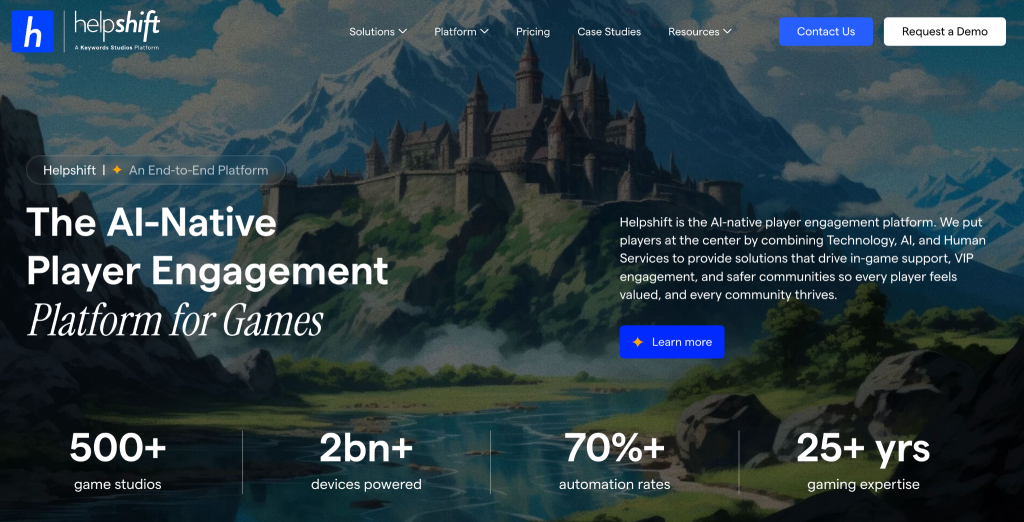
Helpshift is the AI-native player engagement platform, a Keywords Studios platform, built specifically for gaming studios and other player-driven businesses. Where general CX platforms treat gaming as one industry among many, Helpshift starts from the game itself: a native in-game SDK, Care AI as its flagship agentic AI, and a human layer of gaming specialists from Keywords Studios for the moments that need people.
Helpshift’s top features
- Native in-game SDK: support runs inside the game across iOS, Android, Unity, Unreal, web, PC, and console, plus Discord and a patented QR-code handoff from console to mobile that carries full context.
- Care AI: a gaming-native AI agent that autonomously resolves more than 70% of player conversations, reasoning through the player’s goal and taking multi-step actions within your systems.
- 75+ languages: multilingual coverage across agent conversations, self-service, and FAQs, with cultural localization.
- Keywords Studios human agents: gaming-specialist human agents for VIP care, live-ops spikes, and sensitive escalations, on the same platform.
- Fast migration: studios have moved their entire support stack in as little as 10 days.
Where Helpshift stands out
The in-game SDK keeps players inside the experience while their issue is resolved, and Care AI treats player intents like ban appeals, entitlement sync, missing rewards, and account recovery as first-class player support workflows rather than generalist edge cases.
The human layer means VIP and live-ops moments are handled by people who know gaming, which is exactly where a general concierge agent has less depth.
| Trailmix reached 93% automation while holding a 4.3 CSAT on Match Factory! Rovio hit 91% FAQ deflection across 23 titles with roughly $1.7M in annual savings, and Kixeye lifted CSAT from 3.2 to 4.48 after migrating from a general helpdesk. |
Helpshift’s cons
Helpshift is deliberately gaming-first, so it is not built for non-gaming verticals, and it leads with in-game chat and automation rather than outbound voice. Pricing is custom, so getting a number means a sales conversation.
Helpshift is best for
Gaming studios that want support, automation, and human expertise built into the game rather than bolted on beside it.
2. Sierra
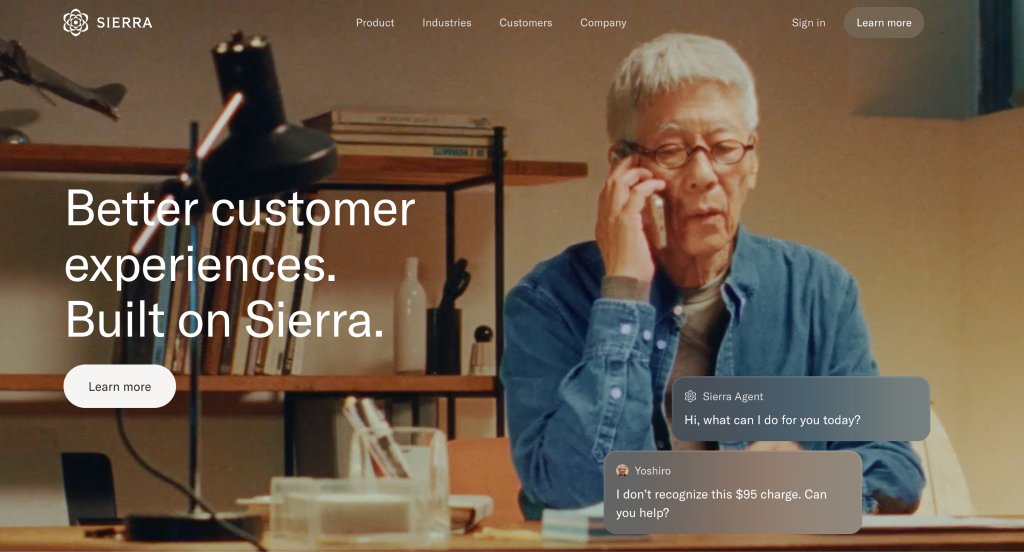
Sierra is Decagon’s closest peer in the enterprise autonomous-agent category. Founded in 2023 by Bret Taylor and Clay Bavor, it deploys agents that hold natural, multi-turn conversations across chat, voice, and digital channels, and connect to CRMs and systems of record to take real action. Its commercial model is built around paying for successful outcomes, and it counts a large share of the Fortune 50 among its customers.
Sierra’s top features
- Multi-turn conversations: natural dialogue across chat, voice, and digital channels.
- Systems integration: connects to CRMs and records to complete real tasks.
- Outcome-based pricing: a commercial model built around successful resolutions.
Where Sierra stands out
Sierra is strong at high-stakes, cross-industry enterprise support, with mature governance and a natural conversation quality that reviewers consistently credit. For very large general-CX operations, it is a direct like-for-like to Decagon.
Sierra’s cons
On G2, reviewers flag a learning curve and a UI that can feel overwhelming for new users, occasional slowness and bugs, and agents that can lose context in longer conversations, sometimes turning generic mid-session. Several also note that many configuration changes still require Sierra’s team rather than self-service.
Sierra is best for
Large enterprises that want a general-purpose autonomous agent with strong governance.me-based pricing models.
3. Fin by Intercom
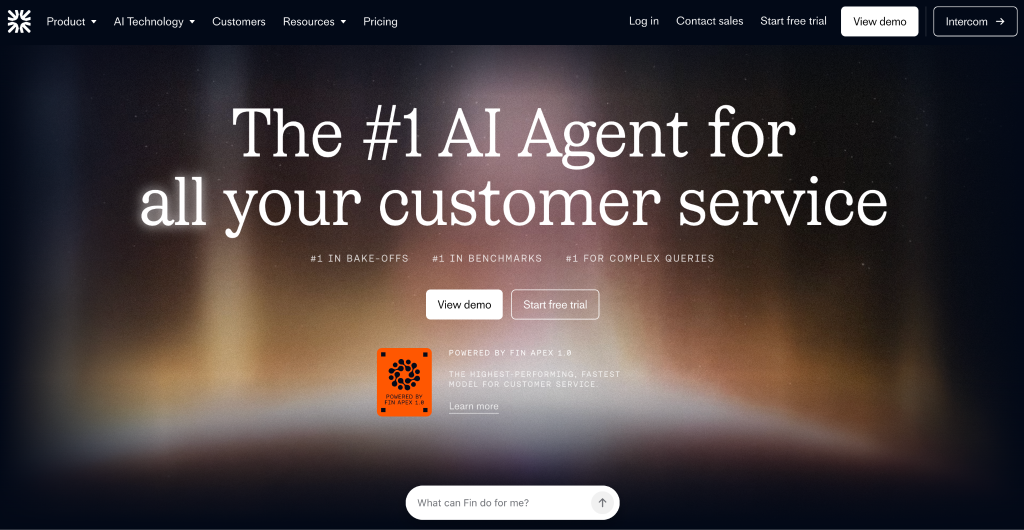
Fin is Intercom’s AI agent, built into the Intercom platform and available on other helpdesks as well. It draws on your help center and conversation history to answer questions and resolve issues, and it is the product that made per-resolution pricing a category talking point. Its public rate is $0.99 per resolution, which is rare in a market full of quote-only contracts and makes budgeting straightforward.
Intercom Fin’s top features
- Public per-resolution price: $0.99 per resolution, simple to model.
- Helpdesk-native: turns on fast for teams already in Intercom.
- Knowledge-grounded answers: draws on help center content and past conversations.
Where Intercom Fin stands out
Transparency and speed. If your team already lives in Intercom, Fin turns on quickly, and its published price lets you forecast cost against your resolution volume in a spreadsheet, a sharp contrast to Decagon’s sales-led quotes.
Intercom Fin’s cons
G2 reviewers say total cost gets harder to forecast as Fin resolutions and add-ons stack, and some report slower support responses on billing questions. Fin’s answer quality also leans heavily on how well the help center is maintained, and Salesforce’s mid-2026 agreement to acquire Fin means packaging could shift over time.
Intercom Fin is best for
Support teams that want a fast, budget-predictable AI agent on an existing helpdesk.
4. Salesforce Agentforce
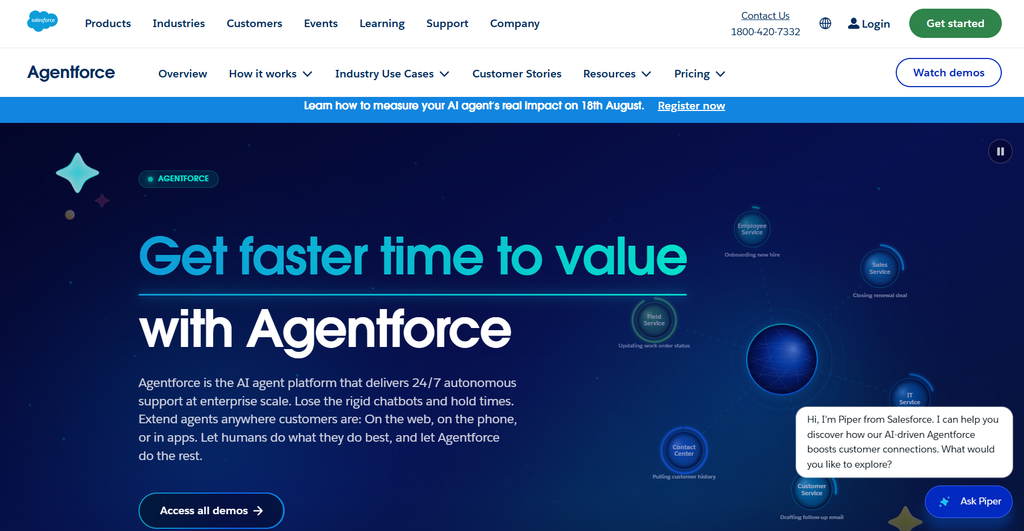
Agentforce is Salesforce’s autonomous service agent, built on the Agentforce 360 Platform and designed to deploy across voice, web, portal, and messaging from a single setup screen.
Its Help Agent moved to outcome-based pricing in 2026 at a publicly stated $2 per autonomous resolution, with no charge when a customer escalates to a human or leaves unsatisfied. It connects natively to Salesforce Knowledge and the broader Service Cloud stack.
Salesforce Agentforce’s top features
- Outcome pricing: $2 per autonomous resolution, no charge on escalation.
- Service Cloud native: pulls from data and knowledge the team already maintains.
- Multi-surface deploy: voice, web, portal, and messaging from one setup screen.
Where Salesforce Agentforce stands out
For organizations already standardized on Salesforce, Agentforce arrives pre-configured and pulls from data and knowledge the team already maintains, which shortens the path to a working agent.
Salesforce Agentforce’s cons
On G2, reviewers describe a steep learning curve that often needs training and planning, complex initial setup and configuration, and licensing that gets expensive once AI add-ons stack. Several note the AI only delivers real value once the underlying Salesforce data and processes are well established.
Salesforce Agentforce is best for
Enterprises whose service operation is already centered on Salesforce.
5. Ada
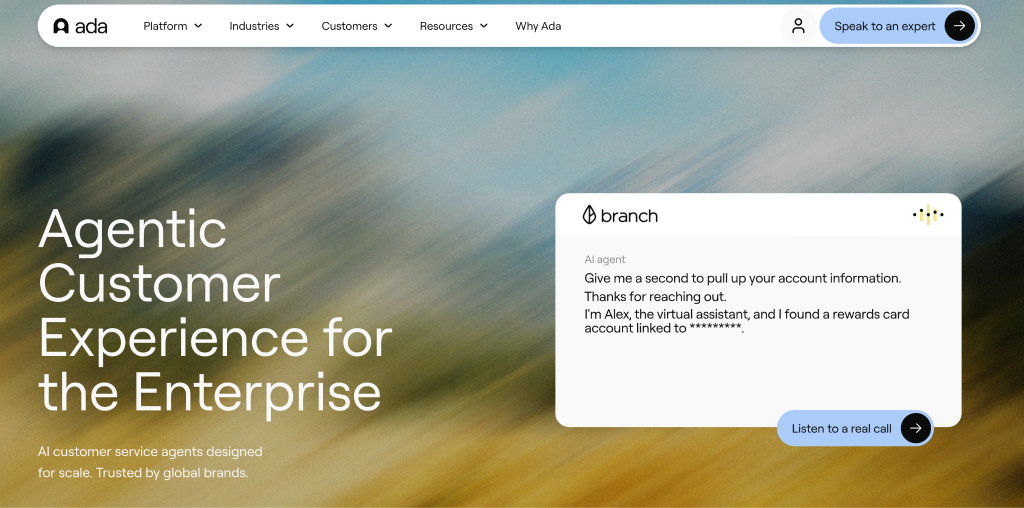
Ada is an enterprise AI customer experience platform founded in 2016 in Toronto, built around a no-code builder and a reasoning engine that follows compliance-sensitive playbooks. It deploys agents across chat, email, voice, and social, with broad multilingual coverage and a solid compliance posture including SOC 2, HIPAA, GDPR, and CCPA, which matters to regulated buyers.
Ada’s top features
- No-code builder: non-technical teams build and adjust automations.
- Broad multilingual coverage: wide language support for global teams.
- Compliance posture: SOC 2, HIPAA, GDPR, and CCPA.
Where Ada stands out
Non-technical teams can build and adjust automations without engineering, and Ada’s multilingual coverage and certifications make it a comfortable fit for global, regulated enterprises that need deeper role and access control than a younger product may offer.
Ada’s cons
G2 reviewers would like more detailed, customizable reporting, and some report integration friction that can make automations inconsistent. Others hit limits when building more dynamic workflows, and note the agent leans heavily on official help-center content for its answers.
Ada is best for
Regulated, multilingual enterprises that want a no-code platform they can run in-house.t strong analytics and multilingual automation with minimal engineering dependency.
6. Zendesk AI
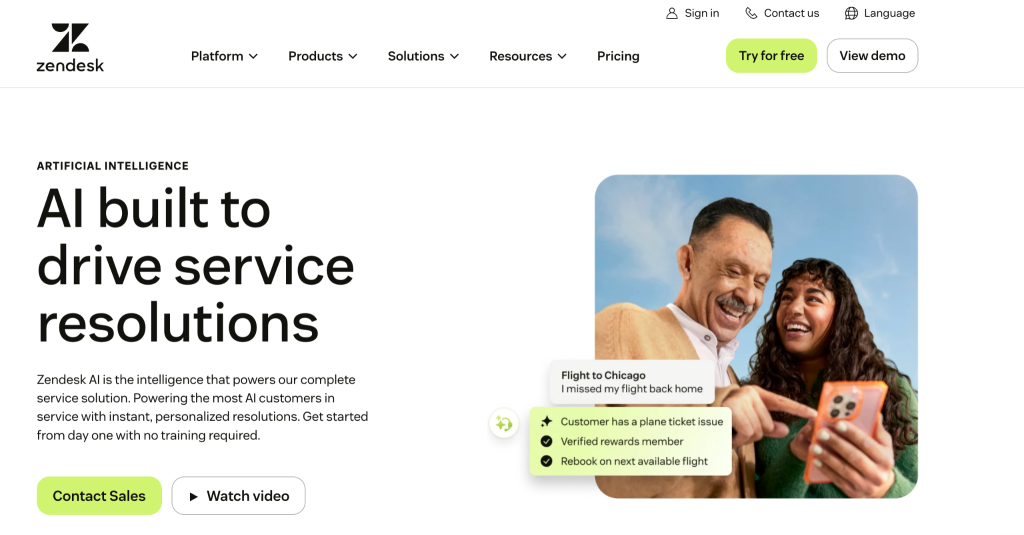
Zendesk AI is the autonomous-resolution layer inside the Zendesk Resolution Platform, deepened in 2026 when Zendesk folded in agentic capabilities from its Forethought acquisition. For the very large population of teams already running Zendesk, it resolves issues end to end and reports through the same analytics and workflows the team already uses.
Zendesk AI’s top features
- Native to Zendesk: no separate stack to stand up.
- Unified workspace: AI and human conversations share one environment.
- Resolution Platform: autonomous resolution alongside familiar reporting.
Where Zendesk AI stands out
It is native to Zendesk. There is no separate stack to stand up, and human and AI conversations share one environment, which keeps reporting and routing unified.
Zendesk AI’s cons
Zendesk AI has a learning curve that often requires team to opt for a dedicated admin, AI-resolution pricing stacked on seats that can be hard to predict, and an analytics redesign that took some long-time users time to adjust to.
Zendesk AI is best for
Existing Zendesk customers adding AI resolution to their current setup.
7. Cognigy (NICE)
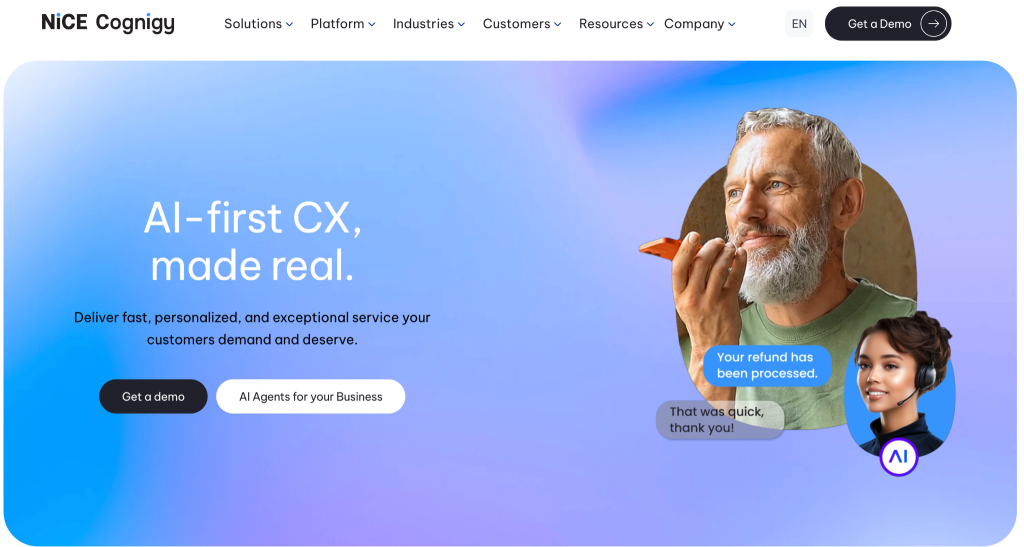
Cognigy, now part of NICE, is an enterprise conversational AI platform known for voice. It pairs a low-code, visual flow builder with strong IVR and contact-center integrations across major CCaaS providers, and supports 100+ languages, which makes it a natural fit for voice-first operations.
Cognigy’s top features
- Voice and IVR depth: built for phone-first operations.
- CCaaS integrations: connects across major contact-center providers.
- Low-code builder: visual flows for complex journeys, plus 100+ languages.
Where Cognigy stands out
Voice and contact-center depth. For enterprises whose volume is phone-first, Cognigy’s IVR handling and CCaaS integrations are a core strength rather than an add-on.
Cognigy’s cons
Reviewers cite limited analytics and constraints on more advanced chat flows, and note the platform does not support very extensive workflows out of the box. Advanced builds and integrations tend to need developer support, with documentation gaps on complex flows.
Cognigy is best for
Voice-first enterprise contact centers that need deep IVR and CCaaS integration.
How to Choose the Right Decagon Alternative
Two quick tools before you commit: the questions that surface real differences, and a fast map from profile to platform.
1. Questions to ask every vendor
- How does pricing scale with volume spikes, and exactly how do you define a resolution or conversation for billing?
- How does the agent behave during sudden traffic surges, not just sustained high volume?
- What is your accuracy benchmark on the specific intents that drive most of my volume?
- How mature are roles, permissions, and audit logs, and what does that mean for regulated workflows?
- Which channels and helpdesks do you integrate with natively, and how does work hand off from the AI agent to a human agent?
2. Quick fit-by-profile guide
- Gaming studios: Helpshift
- General enterprise CX: Sierra
- Already on Zendesk or Intercom: Zendesk AI or Intercom Fin
- Salesforce shops: Salesforce Agentforce
- Regulated or multilingual enterprise: Ada
- Voice-first contact centers: Cognigy
Where Helpshift Fits in the Decagon Alternative Landscape
The platforms on this list compete as generalist AI agents that can be pointed at any industry. Helpshift is the exception: it is built for gaming first. That difference shows up in the details that decide player retention.
Support runs on a native in-game SDK, so players never have to leave the game to get help. Care AI understands gaming intents natively, so ban appeals, entitlement sync, and account recovery are handled as real workflows. Coverage spans 75+ languages for a global player base, and the Keywords Studios human layer steps in for VIP care and live-ops surges with full context.
For a sense of what that looks like in practice, see how studios run round-the-clock, multilingual player support without multiplying headcount.
The proof is in named-studio outcomes. Trailmix, Rovio, KRAFTON, Kixeye, and Jam City run player support on Helpshift because the alternative is stitching several general platforms together and hoping the handoffs hold in production during a launch. If gaming is your world, the right question is not which generalist concierge agent is strongest, but which platform was designed for players in the first place.
See Why Gaming Studios Choose Helpshift Over General AI Agents
If you are weighing Decagon and your players are the business, Helpshift is built for exactly this. It brings the in-game SDK, Care AI for autonomous resolution, and Keywords Studios gaming specialists together on one platform, so support lives inside the game instead of beside it. Studios have made the switch in as little as 10 days. Request a Helpshift demo to see Care AI resolve real player workflows on your titles.
Frequently Asked Questions
1. What does Decagon AI cost?
Decagon does not publish pricing. It is quote-only and sold through sales, typically a platform fee plus per-conversation or per-resolution usage, with annual commitments that third-party analyses place well into six figures. Because there is no public rate, model total cost against your expected volume, and confirm how a billable resolution is defined before signing.
2. Which Decagon alternative is best for gaming studios?
Helpshift. It is the only option on this list built for gaming, combining a native in-game SDK with Care AI, which autonomously resolves more than 70% of player conversations, plus gaming-specialist human agents from Keywords Studios. Studios such as Trailmix (93% automation, 4.3 CSAT) run their player support on it.
3. Which Decagon alternative is fastest to implement?
If you already run Intercom or Zendesk, a native AI agent on that stack, such as Intercom Fin, is typically fastest to switch on. Among gaming-native options, Helpshift has migrated full support stacks in as little as 10 days.
4. Can these alternatives handle multilingual support, and how deep?
Yes, though depth varies. Helpshift covers 75+ languages across automation, self-service, and human conversations with cultural localization. Ada and Cognigy both offer broad multilingual coverage for global enterprises. Confirm whether coverage applies to automated resolution, human agents, and self-service content, not just the interface.
5. When should voice capability drive the decision?
When your volume is phone-first. If most contacts come through voice or IVR, prioritize a platform built around it, such as Cognigy, or Salesforce Agentforce within the Salesforce stack. If support is chat-first or lives inside a game, a chat and in-game-native platform like Helpshift is the better match.
6. How is Helpshift different from Decagon?
Decagon is a general enterprise concierge platform for chat, email, and voice across many industries. Helpshift is gaming-native: it adds a native in-game SDK, gaming-tuned Care AI for player-specific workflows, and a human layer of gaming specialists, so support is designed around players rather than configured toward them.