




AI is rapidly eliminating routine customer service tasks, allowing teams to redirect their focus toward higher-value, strategic work. This transformation is now less about if and more about how fast the industry moves. As one Director of Product Management from our survey noted, “If we can deliver better support, faster, to players in larger volumes, this only makes the player experience better. And if we can do it at a better cost, it’s really a no-brainer.”
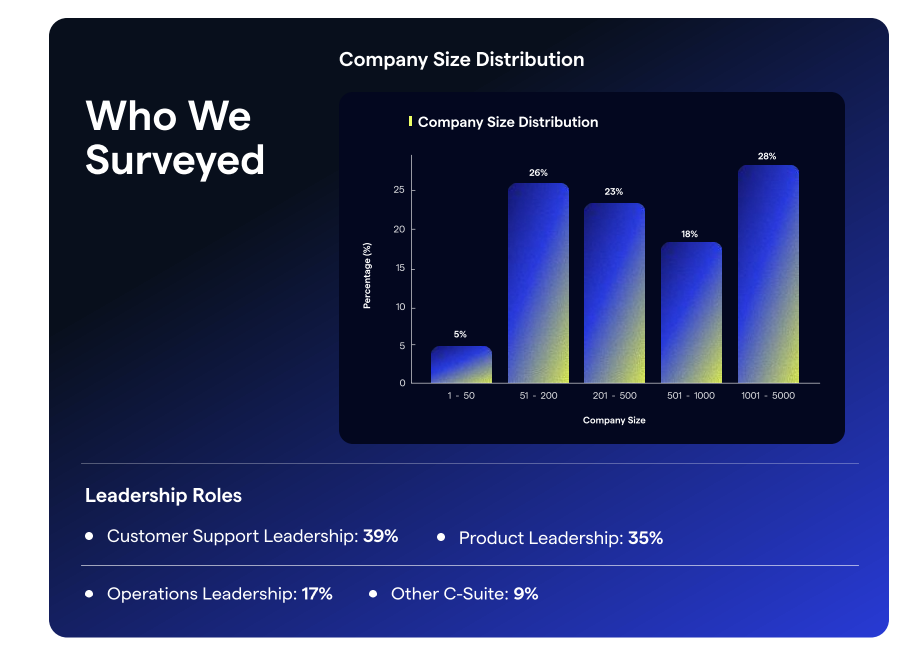
To understand how successful gaming companies are investing in and implementing AI, we surveyed over 50 senior leaders on their current adoption status and the challenges they face.
| Universal Agreements: 5 Facts Every Gaming Leader Agrees On These facts underscore the seismic shift underway in player support and customer experience (CX).AI adoption is inevitable and no longer theoretical. Mass experimentation and adoption are underway. 94% of studios are already using AI in some capacity.AI will be the primary interface for player support. A staggering 80% of leaders agree this shift will happen within the next five years.The transformation timeline is accelerating. 39% report that transformation is already happening, with another 45% expecting it within two years.The future is a powerful human–AI partnership. It is not about AI replacing humans, but augmenting their capabilities.A catalyst for superior CX. Gaming leaders are united by a shared commitment to delivering the best possible player experience, and AI is emerging as the key catalyst to make that vision a reality. To get the full insights, including detailed data on adoption rates, read the full report here. |
Three Distinct Mindsets Toward AI Adoption
Our survey revealed three distinct mindsets toward AI adoption — explorers, pioneers, and observers — each representing a unique stage in this transformation and highlighting different priorities and challenges.
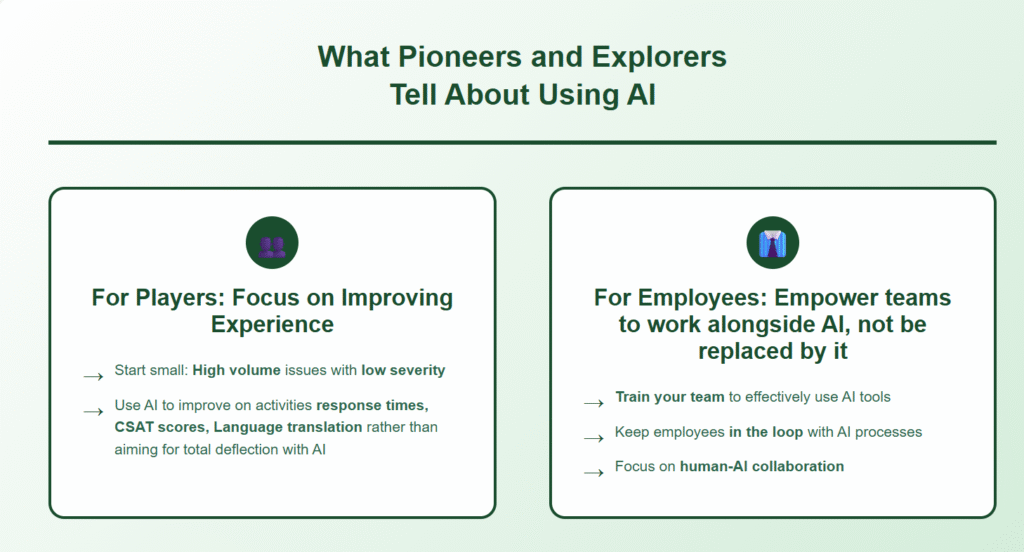
What Pioneers and Explorers say about using AI
Explorers
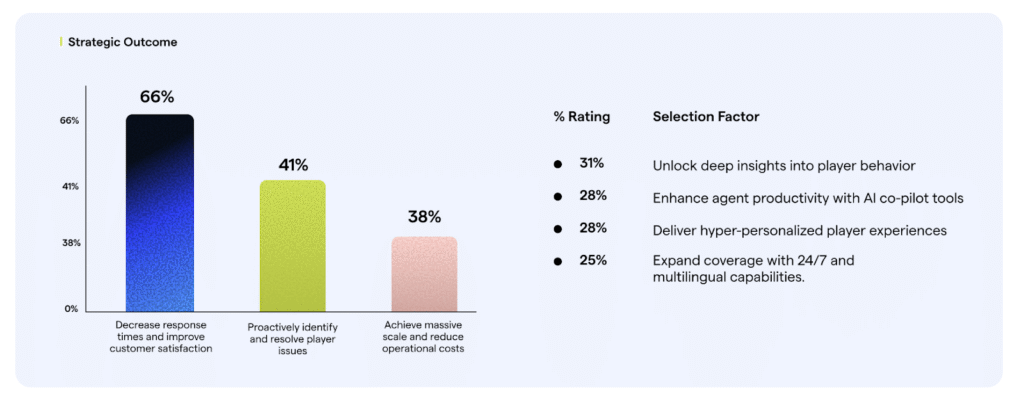
Explorers are leaders actively investing in AI solutions, integrating them into their tech stacks and undergoing transformation. After implementing AI, they’re observing measurable improvements: higher CSAT scores, enhanced agent productivity, greater scale, and reduced response times and costs.
When selecting AI solutions, Explorers prioritize three key factors: integration capabilities, cost, and accuracy.
Want to know what their next phase of AI transformation will be? Read the full report here.
Pioneers
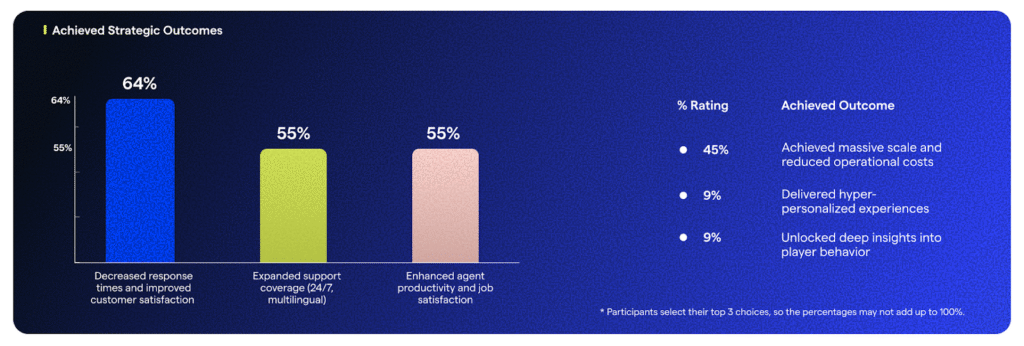
Pioneers have already made significant investments in AI implementation and are now witnessing tangible results: decreased response times, improved CSAT scores, enhanced agent productivity and satisfaction, and expanded language support.
Having already demonstrated AI’s value in handling foundational and repetitive tasks, Pioneers are now looking toward a major leap in capability. The next phase of innovation centers on autonomous resolution of complex, multi-step player issues, a priority for 91% of respondents.
| To read more about how pioneers measure ROI on AI adoption, extended benefits, and future phases of AI implementation, download our complete guide here. |
Observers
Observers, comprising about 6% of respondents, haven’t yet invested in or implemented AI transformation. However, they accept AI’s inevitability and believe it will become the primary interface for player support within five years.
For Observers, it’s not a question of why but when.
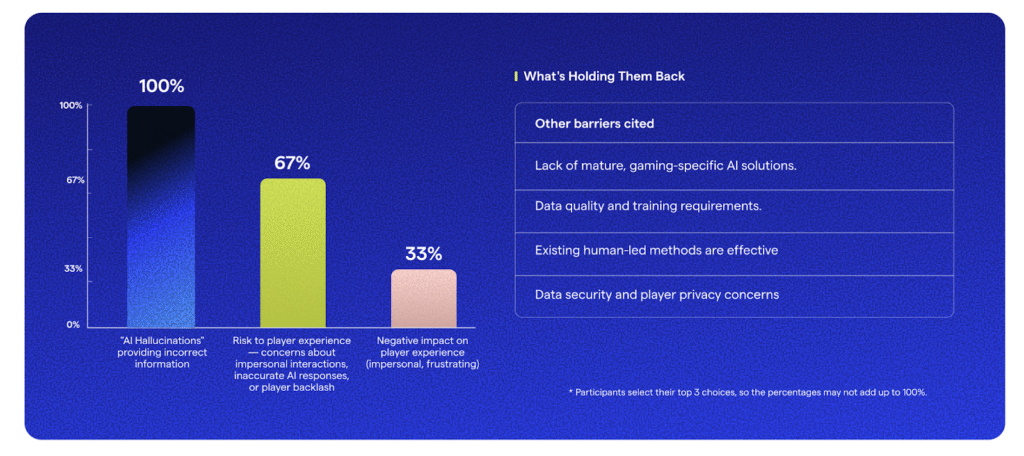
They’ll increase AI usage only when its reliability and accuracy are unconditionally proven. Many feel that player experience and ticket resolution still benefit from a human touch, reason enough not to disrupt the status quo.
Both Explorers and Pioneers believe that with proper training and change management, there will always be a human in the loop, especially for high-value players, and to handle support that requires empathy and human judgment that automated systems cannot.
What’s Next: As reported by all three of these cohorts?
The gaming industry’s journey with AI reveals a powerful pattern: experience breeds confidence. Those who have moved from theory to practice report the highest optimism, discovering that AI’s operational reality validates rather than diminishes its promise.
A remarkable consensus cuts across all adoption stages: AI will fundamentally reshape player relationship management within the next five years, with transformation timelines compressing faster than initially expected.
Yet this shared vision comes with a sobering recognition: every challenge, regardless of cohort, ultimately traces back to the same core concern: protecting player trust.
The way forward is to implement AI with purpose. Companies will view AI as a co-pilot rather than a replacement, that prioritize player experience over pure efficiency, and that recognize the enduring value of human creativity, empathy, and community understanding.