
Sierra raised the bar for enterprise customer service AI. Founded in 2023 by Bret Taylor and Clay Bavor, it fields autonomous agents that hold natural, multi-turn conversations and act inside a company’s systems across chat, voice, and digital channels. Reviewers on G2 credit its conversation quality and its hands-on onboarding, and Sierra now serves a large share of the Fortune 50.
So why do teams still keep a shortlist? The reasons are about fit, not fault. Sierra does not disclose pricing, and G2 reviewers point to cost uncertainty when they cannot see a number early. The platform is tuned for general enterprise CX across sectors like retail, telecom, and financial services, which leaves buyers with one dominant vertical wanting an agent built for their exact workflows. And nothing in Sierra’s design speaks to players, live-service events, or in-game support.
This guide walks through the seven best Sierra AI alternatives for 2026, what each one is, where it wins, where it fits, and who it suits. The order reflects use-case fit, not a scored ranking.
What Sierra AI Is and Why Teams Explore Alternatives
Sierra is an enterprise conversational AI platform for customer service. Its agents connect to CRMs, order systems, and subscription tools to resolve issues end to end rather than hand over a help article, and it charges around successful outcomes. That is a strong package, which is why Sierra sits on almost every enterprise shortlist. The points below are fit considerations drawn from patterns in Sierra’s verified G2 reviews, not criticisms.
1. Pricing is quote-only and enterprise-sized
Sierra publishes no rates. G2 reviewers cite difficulty gauging long-term value before signing, and third-party analyses commonly place deployments in six figures per year. Teams that want to forecast spend against volume, or that sit below enterprise scale, often prefer a platform with a public per-resolution price.
2. Built for general CX, not one vertical
Sierra’s depth is cross-industry. Buyers whose volume concentrates in a single domain, such as gaming or a specific regulated workflow, frequently want an agent whose understanding is tuned to those intents out of the box rather than configured toward them over time.
3. Context in longer conversations
Some G2 reviewers note that in longer or more complex threads, unaided responses can become generic or repetitive. The practical response is earlier human escalation or more workflow refinement, worth scoping during a proof of concept.
4. No gaming specialization
Sierra is a general chat and voice product. There is no native in-game SDK, and player journeys like ban appeals, entitlement sync, missing rewards, and account recovery are not first-class workflows. For studios, that gap usually decides the search.
Sierra AI Alternatives at a Glance
The table below summarizes where each alternative fits and what sets it apart from Sierra, with Helpshift first as the only gaming-native option.
| Platform | Best for | Starting price | Where it stands out vs Sierra |
| Helpshift | Gaming studios and player-driven apps | Custom (per-issue) | Native in-game SDK plus Care AI for player workflows |
| Decagon | High-volume consumer brands | Custom (per-conversation or per-resolution) | Plain-language Agent Operating Procedures at scale |
| Intercom Fin | Teams that want transparent usage pricing | $0.99 per resolution (publicly listed) | A public price you can model up front |
| Salesforce Agentforce | Salesforce and Service Cloud shops | $2 per resolution (publicly listed) | Native to the Salesforce stack |
| Ada | Enterprise, no-code, multilingual | Custom | No-code build with broad language coverage |
| Zendesk AI | Teams already on Zendesk | Custom | Native to the Zendesk Resolution Platform |
| Cognigy (NICE) | Voice-first enterprise contact centers | Custom | Deep voice and IVR with CCaaS integrations |
Top 7 Sierra AI Alternatives and Competitors
The list below covers 7 best Sierra alternatives. Every entry covers what the platform is, its standout strengths, and the buyer it suits, so you can match a shortlist to your own channels, volume, and budget.
1. Helpshift
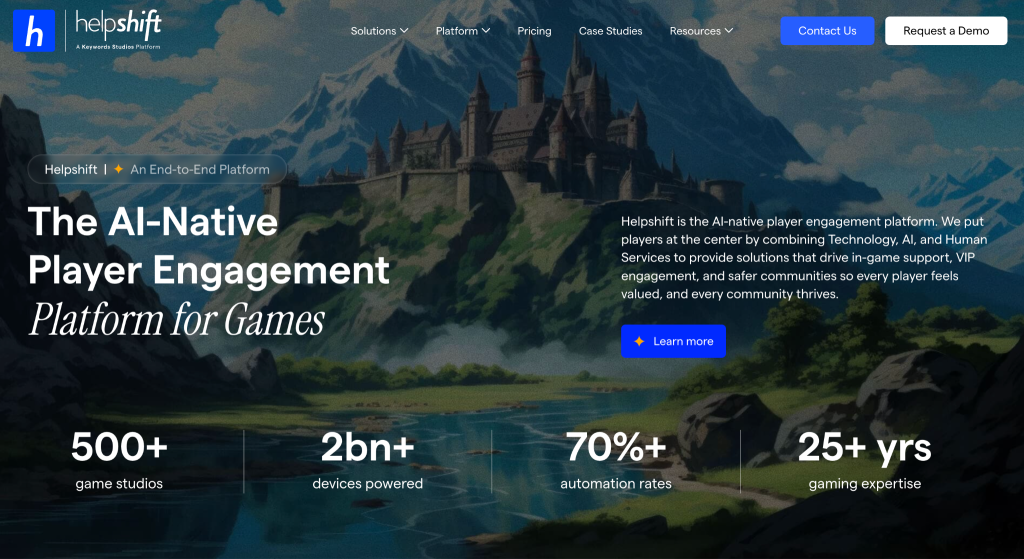
Helpshift is the AI-native player engagement platform, by Keywords Studios, built specifically for gaming studios and player-driven apps. Where general CX platforms treat gaming as one industry among many, Helpshift starts from the game itself. It has a native in-game SDK, Care AI as its flagship agentic AI, and gaming specialists from Keywords Studios for the moments that need people.
Helpshift’s top features
- Native in-game SDK: support runs inside the game across iOS, Android, Unity, Unreal, web, PC, and console, plus Discord and a patented QR-code handoff from console to mobile that carries full context.
- Care AI: a gaming-native AI agent that autonomously resolves more than 70% of player conversations, reasoning through the player’s goal and acting inside your systems.
- 75+ languages: multilingual coverage across agent conversations, self-service, and FAQs, with cultural localization.
- Keywords Studios human agents: gaming specialists for VIP care, live-ops spikes, and sensitive escalations, on one platform.
- Fast migration: studios have moved an entire support stack in as little as 10 days.
Where Helpshift stands out
The in-game SDK keeps players inside the experience while their issue is resolved, and Care AI handles player intents like ban appeals, entitlement sync, and account recovery as core player support workflows rather than generalist edge cases. The human layer covers VIP and live-ops moments with people who know gaming, exactly where a general autonomous agent has less depth.
| Kixeye moved off a general helpdesk to Helpshift and lifted CSAT from 3.2 to 4.48, reaching roughly 90% deflection. Read the Kixeye case study. |
Helpshift’s cons
Helpshift is deliberately gaming-first, so it is not built for non-gaming verticals, and it leads with in-game chat and automation. It does not specialize in outbound voice. Pricing is custom rather than public self-serve, so getting a number means a sales conversation.
Helpshift is best for
It is suitable for gaming studios that want support, automation, and human expertise built into the game.
2. Decagon
Decagon is Sierra’s closest peer in the autonomous-agent category, founded in 2023 and built around Agent Operating Procedures that let non-technical managers describe workflows in plain language. It handles chat, email, and voice, with a roster of high-volume consumer brands that includes a gaming name, Riot Games.
Decagon’s top features
- Agent Operating Procedures: plain-language logic that compiles into agent behavior.
- Omnichannel resolution: autonomous handling across chat, email, and voice.
- Watchtower monitoring: always-on quality checks on agent responses.
Where Decagon stands out
Decagon is strong at high-throughput consumer support where workflows are well defined, and its natural-language procedures make it approachable for support-ops teams.
Decagon’s cons
On G2, reviewers point to slower responses and more escalation during sudden traffic surges, and note that roles, permissions, and audit logs are still maturing for regulated teams.
Decagon is best for
High-volume consumer brands that want deterministic, procedure-driven autonomous agents.
3. Fin by Intercom
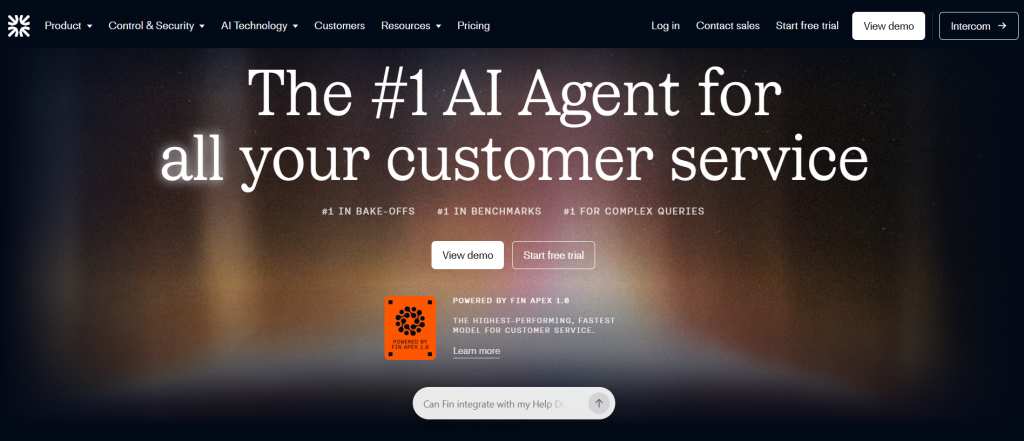
Fin is Intercom’s AI agent, built into the Intercom platform and available on other helpdesks too. It answers from your help center and conversation history, and it made per-resolution pricing a category talking point with a public rate of $0.99 per resolution.
Intercom Fin’s top features
- Public per-resolution pricing: $0.99 per resolution, easy to model.
- Helpdesk-native: turns on fast for teams already in Intercom.
- Knowledge-grounded answers: draws on help center and past conversations.
Where Intercom Fin stands out
Transparency and speed. The published price lets you forecast cost against resolution volume in a spreadsheet, a clear contrast with Sierra’s sales-led quotes.
Intercom Fin’s cons
G2 reviewers find total cost hard to forecast as Fin resolutions and add-ons stack, cite occasional slow support on billing questions, and note Fin’s accuracy tracks how well the help center is maintained.
Intercom Fin is best for
Intercom Fin is great for support teams that want a fast, budget-predictable AI agent on an existing helpdesk.
4. Salesforce Agentforce
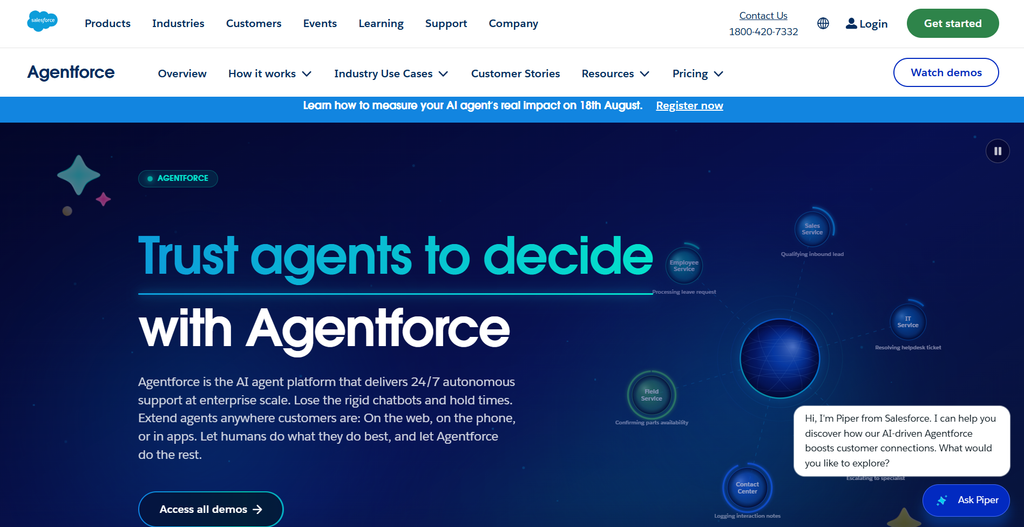
Agentforce is Salesforce’s autonomous service agent, built on the Agentforce 360 Platform and deployable across voice, web, portal, and messaging from one setup. Its Help Agent moved to outcome pricing in 2026 at a public $2 per autonomous resolution, connecting natively to Salesforce Knowledge and Service Cloud.
Salesforce Agentforce’s top features
- Outcome pricing: $2 per autonomous resolution, no charge on escalation.
- Service Cloud native: pulls from data and knowledge the team already maintains.
- Multi-surface deploy: voice, web, portal, and messaging from one console.
Where Salesforce Agentforce stands out
For organizations already standardized on Salesforce, Agentforce arrives pre-integrated, which shortens the path to a working agent.
Salesforce Agentforce’s cons
On G2, reviewers describe a steep learning curve and complex setup, licensing that climbs as AI add-ons stack, and value that only lands once Salesforce data and processes are mature.
Salesforce Agentforce is best for
Enterprises whose service operation already runs on Salesforce.
5. Ada
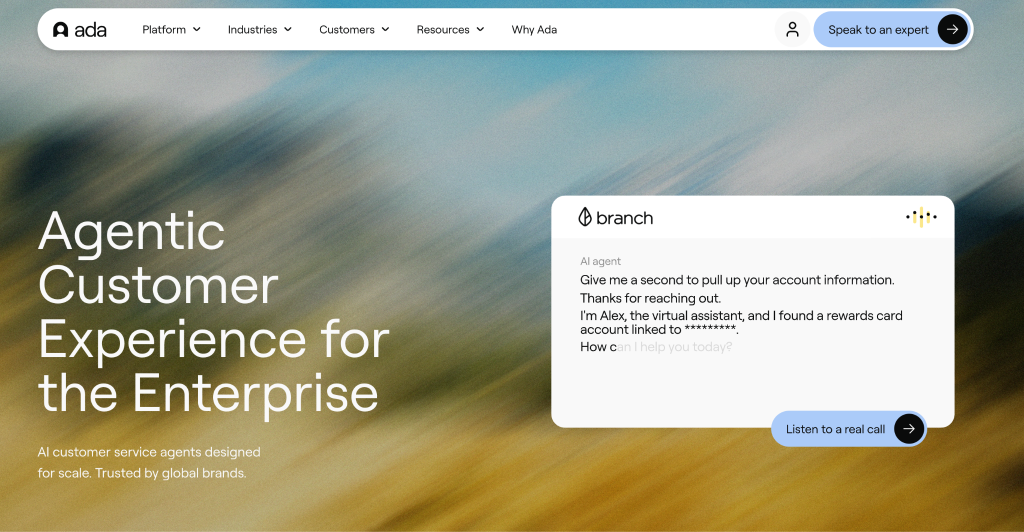
Ada is an enterprise AI customer experience platform founded in 2016 in Toronto, built around a no-code builder and a reasoning engine that follows compliance-sensitive playbooks across chat, email, voice, and social.
Ada’s top features
- No-code builder: non-technical teams build and adjust automations.
- Broad multilingual coverage: wide language support for global teams.
- Compliance posture: SOC 2, HIPAA, GDPR, and CCPA.
Where Ada stands out
Non-technical control plus language breadth and certifications make Ada a comfortable fit for global, regulated enterprises.
Ada’s cons
G2 reviewers want deeper, more customizable reporting, flag integration friction that can make automations inconsistent, and note the agent leans heavily on official help-center content.
Ada is best for
Regulated, multilingual enterprises that want a no-code platform to run in-house.ams that want strong analytics and multilingual automation with minimal engineering dependency.
6. Zendesk AI
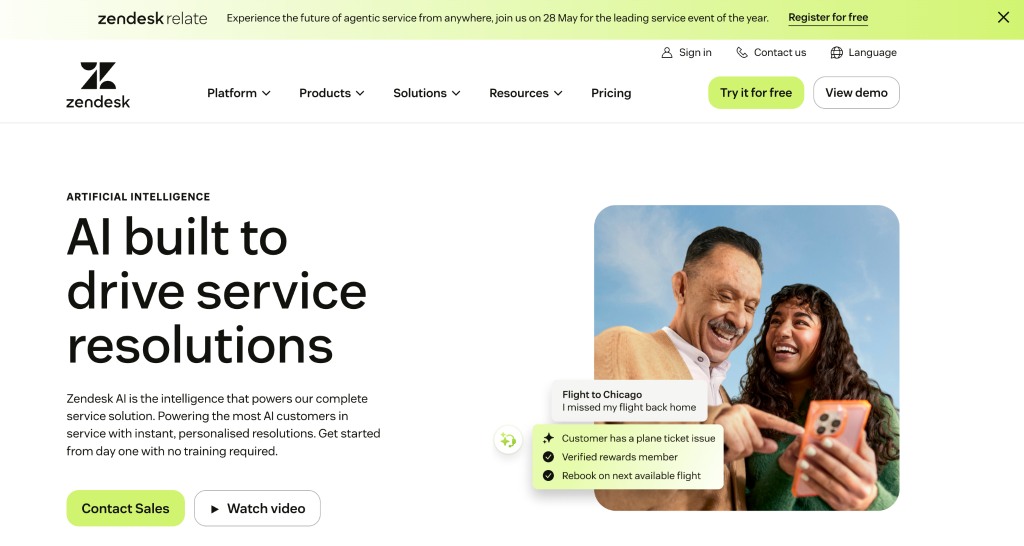
Zendesk AI layers AI Agents, Intelligent Triage, and Agent Copilot on top of the most established support platform on the market. Zendesk’s AI is built on 19 billion historical tickets, giving it broad pattern recognition Zendesk AI is the autonomous-resolution layer inside the Zendesk Resolution Platform, strengthened in 2026 when Zendesk folded in agentic capability from its Forethought acquisition.
Zendesk AI’s top features
- Native to Zendesk: no separate stack to stand up.
- Unified environment: AI and human conversations share one workspace.
- Resolution Platform: autonomous resolution plus reporting in one place.
Where Zendesk AI stands out
For the large population already on Zendesk, it adds autonomous resolution without a platform change, keeping routing and reporting unified.
Zendesk AI’s cons
G2 reviewers cite a learning curve that assumes a dedicated admin, AI-resolution costs that stack unpredictably on seats, and an analytics redesign that took some adjustment.
Zendesk AI is best for
Existing Zendesk customers adding AI resolution to their current setup.
7. Cognigy (NICE)
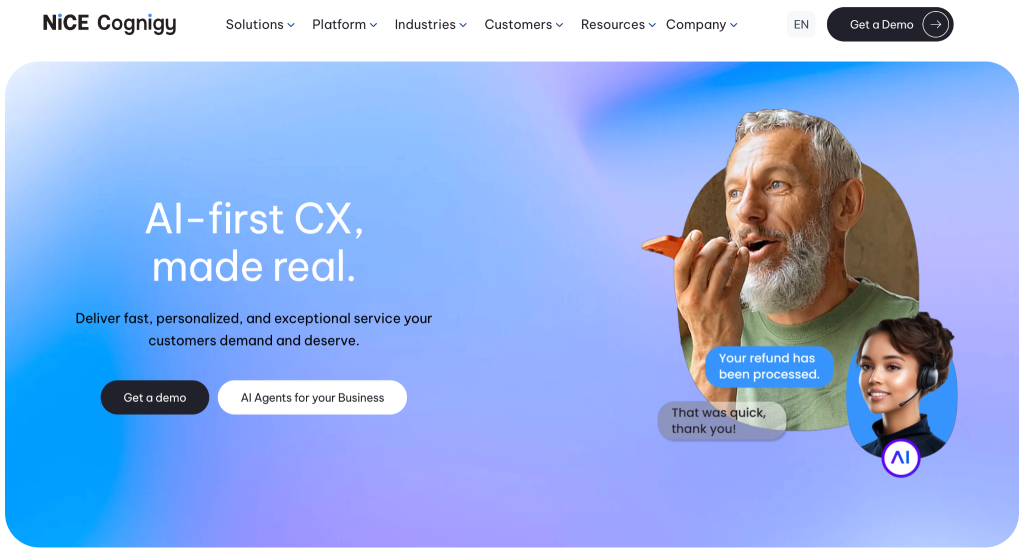
Cognigy, now part of NICE, is an enterprise conversational AI platform known for voice, pairing a low-code visual builder with strong IVR and contact-center integrations and support for 100+ languages.
Cognigy’s top features
- Voice and IVR depth: built for phone-first operations.
- CCaaS integrations: connects across major contact-center providers.
- Low-code builder: visual flows for complex journeys.
Where Cognigy stands out
For enterprises whose volume is phone-first, Cognigy’s IVR handling and CCaaS integrations are a core strength rather than an add-on.
Cognigy’s cons
On G2, reviewers note limited analytics and advanced-flow constraints, say it lacks extensive out-of-the-box workflows, and point to developer dependence with documentation gaps on complex builds.
Cognigy is best for
Voice-first enterprise contact centers that need deep IVR and CCaaS integration.ng voice AI, European compliance, and integration with established CCaaS platforms.
How to Choose the Right Sierra AI Alternative
Use two quick tools to narrow the field. First, ask a few questions that expose real differences, and a use a fast map from profile to platform.
1. Questions to ask every vendor
- How does pricing scale with volume spikes, and how exactly is a “resolution” defined for billing?
- What is your accuracy benchmark on the specific intents that drive most of my volume?
- What is the typical implementation timeline for a deployment my size?
- Which helpdesks do you integrate with natively, and how mature is voice versus chat?
- How does work hand off from the AI agent to a human agent, and what context carries over?
2. Quick fit-by-profile guide
- Gaming studios: Helpshift
- High-volume consumer brands: Decagon
- Already on Zendesk or Intercom: Zendesk AI or Intercom Fin
- Salesforce shops: Salesforce Agentforce
- Regulated or multilingual enterprise: Ada
- Voice-first contact centers: Cognigy
Where Helpshift Fits in the Sierra Alternative Landscape
All except one of the Sierra AI alternatives here compete as generalist AI agents that can point at any industry. Helpshift is the exception, built for gaming first, and that shows up in the details that move player retention. Support runs on a native in-game SDK, so players never leave the game to get help.
Care AI reads gaming intents natively, so ban appeals, entitlement sync, and account recovery are real workflows. Coverage spans 75+ languages, and the Keywords Studios human layer steps in for VIP care and live-ops surges with full context.
To see the operating model in practice, look at how studios run round-the-clock, multilingual player support without multiplying headcount. Also see, how KRAFTON saved $10.6M and reached 75% automation on its BGMI launch with Helpshift. Read the KRAFTON case study.
If gaming is your world, the question is not which generalist agent is strongest, but which platform was designed for players in the first place.
See Why Gaming Studios Switch to Helpshift
Moving off Sierra and building around players? Helpshift brings the in-game SDK, Care AI for autonomous resolution, and Keywords Studios specialists onto one platform, so support lives inside the game instead of beside it, and studios have switched in as little as 10 days. Request a Helpshift demo to watch Care AI resolve real player workflows on your titles.
Frequently Asked Questions
1. What does Sierra AI cost?
Sierra does not publish pricing. It is quote-only and sold through sales, and third-party analyses commonly place deployments in six figures per year. Model total cost against your expected resolution volume, and confirm how a billable outcome is defined before signing.
2. Which Sierra AI alternative is best for gaming studios?
Helpshift. It is the only option here built for gaming, combining a native in-game SDK with Care AI, which resolves more than 70% of player conversations, plus gaming specialists from Keywords Studios. Studios such as Kixeye and KRAFTON run player support on it.
3. Which Sierra AI alternative is fastest to implement?
If you already run Intercom or Zendesk, a native AI agent on that stack, such as Intercom Fin, is usually fastest to switch on. Among gaming-native options, Helpshift has migrated full support stacks in as little as 10 days.
4. Can these alternatives handle multilingual support, and how deep?
Yes, though depth varies. Helpshift covers 75+ languages across automation, self-service, and human conversations with cultural localization. Ada and Cognigy both offer broad multilingual coverage. Confirm whether coverage applies to automated resolution, human agents, and self-service content, not just the interface.
5. When should voice capability drive the decision?
When your volume is phone-first. If most contacts arrive by voice or IVR, prioritize a platform built around it, such as Cognigy, or Salesforce Agentforce within the Salesforce stack. If support is chat-first or lives inside a game, a chat and in-game-native platform like Helpshift is the better match.
6. How is Helpshift different from Sierra?
Sierra is a general enterprise CX platform for chat and voice across many industries. Helpshift is gaming-native, adding an in-game SDK, gaming-tuned Care AI for player-specific workflows, and a human layer of gaming specialists, so support is designed around players rather than configured toward them.