
Decagon vs Zendesk comes down to one choice. Do you add AI to the helpdesk your team already runs? Or do you put a standalone AI agent in front of it?
There can be three paths for teams.
Zendesk AI is the first path. Zendesk bundles AI agents, Copilot, and triage into its Suite plans. In March 2026, it completed its acquisition of Forethought to add self-improving AI agents.
Decagon is the second path. It’s an enterprise AI agent platform built on Agent Operating Procedures (AOPs). It hands off to help desks like Zendesk for human follow-up.
Helpshift is the third option, built for gaming studios. It pairs an in-game SDK with Care AI, its flagship agentic AI. Human gaming specialists from Keywords Studios back it up.
Below, we compare all three on:
- Pricing,
- AI approach,
- Deployment,
- Channels,
- Testing, and
- G2 feedback.
Every competitor fact is dated and linked.
| The short answer:Choose Zendesk AI if you already run Zendesk and want AI inside the same workspace, with published seat pricing.Choose Decagon if you’re an enterprise that wants a custom-configured AI agent in front of your helpdesk and can fund a six-figure contract.Choose Helpshift if you’re a gaming studio that needs support inside the game. |
Decagon vs Zendesk AI at a Glance (Verified October 2026)
Zendesk publishes seat and resolution pricing. Decagon has the higher G2 score from a far smaller review base. Helpshift is the only one built around in-game support.
| Criterion | Helpshift | Decagon | Zendesk AI |
| Best for | Gaming and mobile-first studios supporting players in-game | Enterprises that want a custom-configured AI agent | Teams already on Zendesk, or buying a full helpdesk with AI built in |
| Starting price | Custom and modular (pricing) | Not published; Vendr median $432,750 per year (source) | Suite Team $55 per agent per month; AI resolutions $1.50 committed (pricing) |
| AI approach | Care AI: agentic AI grounded in approved knowledge, with AOPs, guardrails, and in-game actions | AI agents built on AOPs; Duet Autopilot proposes tested improvements | AI agents, Copilot, and triage inside Zendesk; Forethought agents added in 2026 |
| Channels | In-game SDK (mobile, web, PC, console), web, email, social | Chat, email, voice, SMS | Email, chat, messaging, voice, social |
| Helpdesk model | One player engagement platform for AI agents, human agents, and player data | Standalone AI layer that hands off to your helpdesk | AI native to the Zendesk helpdesk |
| Languages | 75+ (Language AI) | Not published | AI agents in 80+ languages (Zendesk-stated) |
| Testing and analytics | Care AI preview environment plus native dashboard (Issues Resolved, CSAT, TTR, TTFR, Reopen Rate) | Duet Autopilot tests changes against regression sets before human approval | Zendesk reporting; Resolution Learning Loop improves agents from resolved tickets |
| G2 rating | 4.3/5 (384 reviews) | 4.8/5 (29 reviews) | 4.3/5 (7,085 reviews) |
Caption: Table compiled from vendor pages, Zendesk’s own Zendesk vs Decagon page, G2 comparison pages, and Vendr data (as reported by Macha)
Note: All sources were checked in September 2026. G2’s Zendesk rating covers the whole Zendesk for Customer Service product.
Why Teams Compare Decagon and Zendesk AI (and Look for Alternatives)
Zendesk is a proven helpdesk, and Decagon earns strong reviews. Teams shop around for three reasons:
- How AI is billed,
- How much they can configure, and
- Whether the platform fits their channels.
1. What G2 Reviewers and Pricing Data Flag About Zendesk
- Missing and limited features are its two most-tagged cons, with 216 and 180 reviews on G2. Out of 7,085 reviews, that’s a small share, but a consistent one.
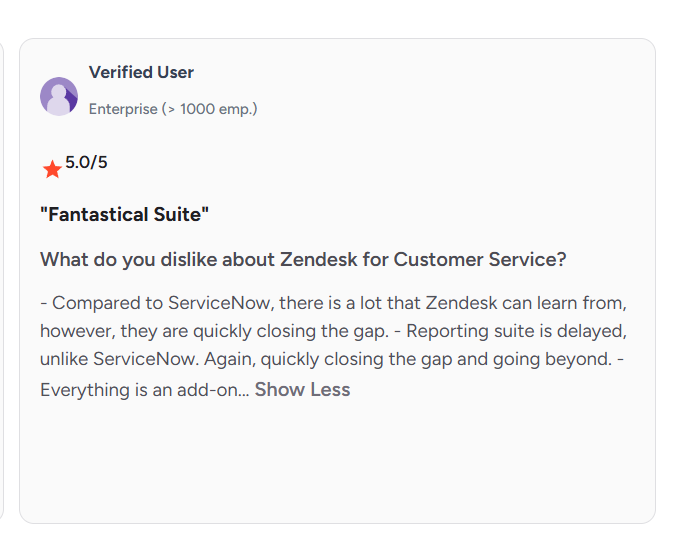
Caption: User reviews on Zendesk’s lack of features
- Setup takes more effort than AI-first rivals. Zendesk scores 8.0 for Ease of Setup, versus Decagon’s 9.0.
- Layered costs. The seat price is only the first line. Copilot adds $50 per agent per month. AI resolutions beyond the included allowance cost $1.50 committed or $2.00 pay-as-you-go (Macha).
- A billing model in motion. Zendesk moved to verified resolutions on May 18, 2026. Assisted escalations and unverified containments are now free, and only verified resolutions are billed. Budget owners should re-model spend after the change.
2. What G2 Reviewers Flag About Decagon
- Missing features and limited customization lead its G2 cons, at 6 and 5 mentions, from 29 reviews.
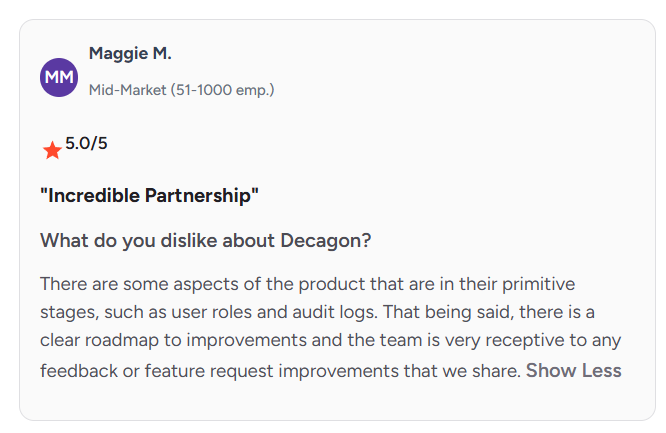
Caption: User reviews about Decagon’s limited features
- No public price. The lowest Vendr-recorded contract is $105,000 a year (Macha, citing Vendr).
- Two systems to run. Decagon sits in front of your helpdesk. Most teams keep paying for Zendesk or another helpdesk alongside it.
3. Where Gaming Studios Feel the Gap With Both
Neither platform is built gaming-first. Missing rewards, failed purchases, ban appeals, and hacked accounts need three things:
Game context,
An entry point inside the game, and
Fast escalation for high-value players.
That’s why Stillfront’s studio Kixeye moved from Zendesk to Helpshift. The migration took 12 weeks, and CSAT rose from 3.2 to 4.48.
What Is Decagon, What Is Zendesk AI, and What Is Helpshift?
Each vendor answers a different question. Decagon is a configurable AI layer. Zendesk AI is AI inside a mature helpdesk. Helpshift is a player engagement platform.
1. What Is Decagon?
Decagon is a conversational AI platform for enterprise customer service. Jesse Zhang and Ashwin Sreenivas founded it in 2023. In January 2026, it raised a $250 million Series D led by Coatue and Index Ventures at a $4.5 billion valuation. That took total funding to about $481 million.
Its AI agents run on AOPs, natural-language procedures that engineers can extend with code. It launched Duet Autopilot in June 2026. Named brands include Avis Budget Group, Block, and Deutsche Telekom.
2. What Is Zendesk AI?
Zendesk AI is the set of AI agents, Copilot, and intelligent triage built into Zendesk’s customer service suite. Zendesk says its AI agent was trained on 18 billion support interactions and supports 80+ languages. It also says more than 10,000 of its 200,000 business customers use it.
On March 26, 2026, Zendesk completed its acquisition of Forethought. The deal added self-improving AI agents that also work across other platforms.
3. What Is Helpshift?
Helpshift is the AI-native player engagement platform. It puts players at the center by combining Technology, AI, and Human Services. Together, these power in-game support, VIP engagement, and safer communities.
Its flagship agentic AI, Care AI, resolves 70%+ of routine player issues autonomously. It then hands off to human gaming specialists with full context. Helpshift, a Keywords Studios platform, works with 500+ game studios.
How We Compared Decagon and Zendesk AI
We judged all three platforms on six criteria that product and technology leaders raise in vendor reviews:
- AI approach,
- Helpdesk fit,
- Channels and languages,
- Deployment,
- Testing and analytics, and
- Pricing transparency.
Facts come from each vendor’s pricing and product pages, company press releases, G2 comparison pages, and Vendr contract data. We checked all of them in September 2026. Vendor-reported figures, such as training data size or benchmark scores, are labeled as vendor-stated.
Note: Where a vendor’s page makes claims about a competitor, we left those out. Helpshift publishes this page. We’ve aimed for accuracy and linked every competitor claim, but confirm live pricing and features before you buy. Spot something outdated? Tell us, and we’ll correct it.
Decagon vs Zendesk AI: Feature-by-Feature Comparison
Decagon wins on builder control. Zendesk wins on ecosystem and helpdesk depth. Helpshift wins wherever the conversation starts in-game.
1. AI Agents: Decagon AOPs vs Zendesk’s Native AI
Decagon’s AI agents follow AOPs written in plain language, while engineering keeps code-level control. Duet Autopilot launched on June 9, 2026. It reviews production conversations, proposes AOP changes, and tests them before a human approves them. It passed 93% of diagnostic tasks on Decagon’s own DuetBench benchmark.
Zendesk builds AI into the helpdesk itself. Its AI agents use a dialogue builder that mixes generative replies with conditional flows and fallback paths. Teams configure them with no-code tools, and Zendesk says they deploy same-day. Forethought’s self-improving agents now sit on the same Resolution Platform.
All three ground answers in approved knowledge, which is how LLM agents keep hallucination risk down. Care AI also uses AOPs for complex cases. It’s set up for game problems: missing rewards, purchase failures, and account access. It takes actions such as tagging, updating tickets, and escalating within the Helpshift platform.
2. Helpdesk Fit and Integrations
Zendesk is the helpdesk. AI agents, human agents, ticketing, and the knowledge base share one workspace. Zendesk lists 1,800+ marketplace integrations.
Decagon sits in front of that stack. G2 reviewers describe integrating it into Zendesk as straightforward. Even so, you’ll run and pay for two systems.
Helpshift keeps the AI agent, human agents, in-game messaging, and player data in one player support platform. When a human agent takes over, they see what Care AI already tried. The player doesn’t have to repeat themselves.
3. Channels, Voice, and Multilingual Coverage
- Zendesk: email, chat, messaging, and social. It also has a full voice stack with IVR, callbacks, routing, and an AI voice agent in 30+ languages (Zendesk-stated).
- Decagon: chat, email, voice, and SMS.
- Helpshift: an in-game SDK across mobile, web, PC, and console. A patented QR-code handoff moves console players to mobile without losing context. Language AI covers 75+ languages. Helpshift doesn’t lead with voice, so voice-heavy contact centers should weigh that.
4. Deployment and Time to Value
For existing Zendesk teams, AI agents switch on inside the current workspace. Zendesk also offers a free trial. Decagon is sales-led. Even so, reviewers rate its setup 9.0, versus Zendesk’s 8.0. Decagon’s team handles most of the configuration.
Helpshift’s timelines come from studios that switched. Kixeye migrated off Zendesk in 12 weeks. It cut time to first human response by 76.8% and saved $100,000 in under six months. TopHatch deployed Care AI in hours and reached 62% full automation in days.
5. Testing, Analytics, and Continuous Improvement
Zendesk’s AI agents improve through its Resolution Learning Loop. It learns from each resolved conversation without manual retraining. Decagon automates the loop through Duet Autopilot, with a person approving every change.
Care AI ships a preview environment that shows the reasoning behind each response. You can see which FAQ, procedure, or guardrail fired. Its native analytics dashboard tracks:
- Issues Resolved,
- CSAT,
- Time to Resolve,
- Time to First Response,
- Reopen Rate, and
- Issue Touches.
6. Security and Compliance
Zendesk lists SOC 2, ISO 27001, GDPR, CCPA, and a HIPAA BAA. Helpshift is certified ISO 27001 and SOC 2 (AICPA). It complies with GDPR, COPPA, and HIPAA. COPPA matters for any game with younger players.
For Decagon, request its current SOC 2 report and HIPAA or GDPR scope during procurement.
Decagon vs Zendesk AI Pricing: What Each Costs in 2026
Zendesk publishes seat prices and a per-resolution meter. Decagon and Helpshift quote custom pricing, and Decagon’s recorded contracts start in six figures.
| Pricing item | Zendesk AI | Decagon | Helpshift |
| Model | Per agent seat, plus automated resolutions beyond the allowance | Per conversation or per resolution, on an annual contract | Modular: interaction volume, solutions activated, capabilities, regions and languages |
| Entry point | Suite Team 55peragentpermonthbilledannually(69 monthly); Support Team $19 is ticketing only | Not published; lowest Vendr-recorded contract $105,000 per year | Request pricing |
| Mid tier | Suite Professional 115peragentpermonth(149 monthly); Enterprise quote-only | Not published | Included in the custom quote |
| AI resolutions | 5 included per agent per month on Suite Team, 10 on Professional; then $1.50 committed or $2.00 pay-as-you-go | Priced into the contract | Priced into the quote |
| AI add-ons | Copilot $50 per agent per month | Quoted per deal | Solutions added without a new contract |
| Typical annual spend | Scales with seats and resolved volume | Vendr median $432,750 (range $105,000 to $923,183, 12 purchases) | Custom |
Caption: Sources include Zendesk pricing as checked by Macha from September 21 to 25, 2026, Vendr data via Macha, and Helpshift pricing*
*Pricing verified in September 2026 and subject to change.
A worked example makes Zendesk’s layers concrete. Take a 20-agent team on Suite Professional. Each month, it pays $2,300 in seats and $1,000 for Copilot. Say AI resolves 500 conversations, and 200 of them are included. The other 300 add $450 at the committed rate, for $3,750 a month in total.
Decagon’s Vendr median works out to about $36,000 a month, usually on top of the helpdesk you keep. That sample covers 12 purchases, so treat it as directional.
For studios, Helpshift prices one commercial relationship across Support, Engagement, Trust & Safety, and Community. That replaces separate contracts for a helpdesk, an AI agent, and outsourced moderation.
Decagon vs Zendesk AI Pros and Cons (With G2 Ratings)
Each platform has a clear strength and a clear trade-off, including Helpshift. Ratings are from G2, checked in September 2026.
1. Helpshift: 4.3/5 on G2 (384 Reviews)
Pros
- In-game SDK across mobile, web, PC, and console, so players never leave the game to get help.
- Care AI resolves 70%+ of routine player issues. It escalates to Keywords Studios gaming specialists with full context.
- One platform for Support, Engagement, Trust & Safety, and Community.
- A proven path off Zendesk: Kixeye migrated in 12 weeks and raised CSAT 40%.
Cons
- Built for gaming and mobile-first brands. A SaaS or retail team gets less from it.
- Doesn’t lead with voice.
2. Decagon: 4.8/5 on G2 (29 Reviews)
Pros
- Highest G2 scores here for Quality of Support (9.5) and Ease of Setup (9.0).
- AOPs give builders fine-grained control over agent behavior.
- Duet Autopilot automates agent improvement, with human approval on every change.
Cons
- No public pricing. Recorded contracts run six figures a year.
- Usually runs alongside a separate helpdesk.
- Missing features, access restrictions, and limited customization.
3. Zendesk AI: 4.3/5 on G2 (7,085 Reviews, Whole Product)
Pros
- Published seat pricing and a free trial.
- AI agents, human agents, ticketing, and knowledge share one workspace.
- Deep ecosystem: 1,800+ marketplace integrations and a full voice stack (Zendesk-stated).
- The largest review base of the three.
Cons
- Total cost stacks up across seats, Copilot, and metered resolutions.
- Missing features and a steep learning curve.
- Ease of Setup scores 8.0, the lowest here.
Decagon or Zendesk AI: Which Should You Choose?
The right pick depends on three things: your current helpdesk, your budget model, and where your conversations start.
- Choose Zendesk AI if you already run Zendesk and want AI in the same workspace as your human agents. It also suits teams that prefer published seat pricing with a metered resolution rate.
- Choose Decagon if you’re an enterprise with high volume across chat, email, and voice. You’ll also need engineers who can own AOPs and budget for a custom annual contract on top of your helpdesk.
- Choose Helpshift if you’re a gaming or mobile-first studio that needs support inside the game. It fits teams that want automation built for player issues and gaming specialists for VIP players and LiveOps spikes.
Comparing more vendors? See our guides to Zendesk alternatives, Decagon alternatives, and Decagon vs Intercom.
Ready to Move Player Support Off Zendesk? See Helpshift in Action
Zendesk and Decagon are built for customer service across every industry. Games need support that opens inside the game. That support has to resolve missing rewards, failed purchases, and account recovery without breaking play.
Helpshift brings an in-game SDK, Care AI, and Keywords Studios gaming specialists together on one platform. Kixeye made the switch from Zendesk in 12 weeks and saved $100,000 in under six months.
Request a demo to see Care AI resolve your top player issues.
Decagon vs Zendesk FAQs
1. What is the main difference between Decagon and Zendesk AI?
Decagon is a standalone AI agent platform configured through AOPs. It’s sold on custom enterprise contracts. Zendesk AI is built into Zendesk’s helpdesk, with published seat pricing and a metered rate for automated resolutions.
2. Is Decagon more expensive than Zendesk AI?
Usually, yes. Vendr data puts Decagon’s median contract at $432,750 a year. By comparison, a 20-agent Zendesk Suite Professional team with Copilot and 500 AI resolutions a month pays about $3,750 a month.
3. Can you use Decagon with Zendesk?
Yes. Many teams run Decagon as the front-line AI agent and Zendesk as the helpdesk for human agents. The trade-off is paying for and maintaining two systems.
4. How does Zendesk charge for AI in 2026?
Each Suite seat includes a small allowance of automated resolutions, 5 to 10 per agent per month. Beyond that, resolutions cost $1.50 committed or $2.00 pay-as-you-go. Since May 18, 2026, only verified resolutions are billed.
5. Which is better for gaming studios: Decagon or Zendesk AI?
Neither is built gaming-first. Studios that support players in-game across mobile, PC, and console usually get more from Helpshift. Its Care AI resolves 70%+ of routine player issues.
6. Is Helpshift better than Zendesk for game studios?
For gaming and mobile-first studios, often yes. Kixeye moved from Zendesk to Helpshift in 12 weeks and lifted CSAT 40%. For non-gaming teams that need a broad helpdesk ecosystem, Zendesk is the simpler fit.