

In recent times, AI’s role in customer service has grown tremendously, transforming how customers interact with businesses and vice versa.
AI customer service platforms use advanced technologies such as predictive analytics, machine learning, and natural language processing to automate responses and workflows, freeing human agents to focus on more complex issues.
For example, Krafton, which launched BATTLEGROUNDS MOBILE INDIA (BGMI), faced challenges managing high volumes of player inquiries and ensuring timely service. Using Helpshift’s AI-enhanced customer service capabilities, Krafton significantly reduced the need for additional agents and saved $10.6 million within a year. You can read about more such stories here.
Most teams start looking for a platform for the same reason: agents spend most of their day answering the same handful of questions, and volume is outgrowing headcount. That is the core job of a customer support automation platform, to resolve the repetitive majority automatically so agents can focus on the cases that actually need judgment. Whether you run support for a SaaS product, an ecommerce store, or a high-volume app, the shortlist below is organized around how much real automation each platform delivers, not just which has the longest feature list.
AI in customer service is here to stay. To help you choose the best AI customer support platform, we’ve vetted the top 12 AI customer service software that will cater to the needs of your support agents and scale to the modern consumer’s expectations.
A comparison chart of different software
| Platform | Best for | Automation strengths | Pricing |
|---|---|---|---|
| Helpshift | AI-native, high-volume and in-product support | Intent detection, RAG-grounded answers, 75+ language AI, smart routing, auto-resolution of the repetitive majority | Starter $150/mo; Growth and Enterprise custom (30-day trial) |
| Zendesk AI | Enterprise teams already on Zendesk | Answer bot, predictive analytics, workflow automation | From $55/agent/mo |
| Salesforce Einstein | Salesforce CRM shops | Einstein Bots, case classification, predictive insights | From $50/user/mo |
| Intercom (Fin) | Chat-first and SaaS teams | Conversational AI, automated workflows, per-resolution AI agent | From $39/seat/mo |
| Freshdesk (Freddy AI) | SMB and budget-conscious teams | Freddy bots, ticketing automation, sentiment analysis | Free plan; Pro $48.99/agent/mo |
| Botpress | Teams that hit a first-gen bot’s ceiling | Resolves L1-L3 tickets, overlays Zendesk/Intercom with no migration | Free; Plus $150/mo; Team $750/mo (no per-seat) |
| LivePerson | Enterprise messaging at scale | Bot Studio, omnichannel automation, agent assist | From $40/mo |
| Ada | No-code automation teams | No-code bot builder, multilingual, workflow automation | Custom |
| Drift | Sales and marketing chat | AI chatbots, playbooks, conversation analysis | From $600/mo (10 seats) |
| Tidio | Ecommerce stores, SMBs, and online brands | Lyro AI agent, up to 75% conversation automation, product recommendations, order updates, lead qualification, customizable chatbots, and automated workflows | Free plan; paid plans from $29/mo ($24.17/mo billed annually). Lyro AI conversation quotas priced separately. |
| Bold360 (Genesys DX) | Enterprise self-service | NLP self-service, AI live chat, analytics | Custom |
| Watson Assistant (IBM) | IT helpdesks and technical teams | NLU, AI training tools, broad integrations | From $140/mo |
12 Best AI Customer Service Platforms
Here are our top picks.
Helpshift

Helpshift is the best AI customer service software, owing to its deeply integrated AI capabilities and omnichannel support.
Helpshift’s key differentiator is its AI-infused support journey, which can automate 70% of customer queries from issue identification to ticket resolution. This differentiating feature is powered by capabilities such as Intent AI, sentiment analysis, real-time language translation, and intelligent routing features. For highly complex queries that urgently require manual intervention, the AI agent can seamlessly hand over the issue to a human agent.
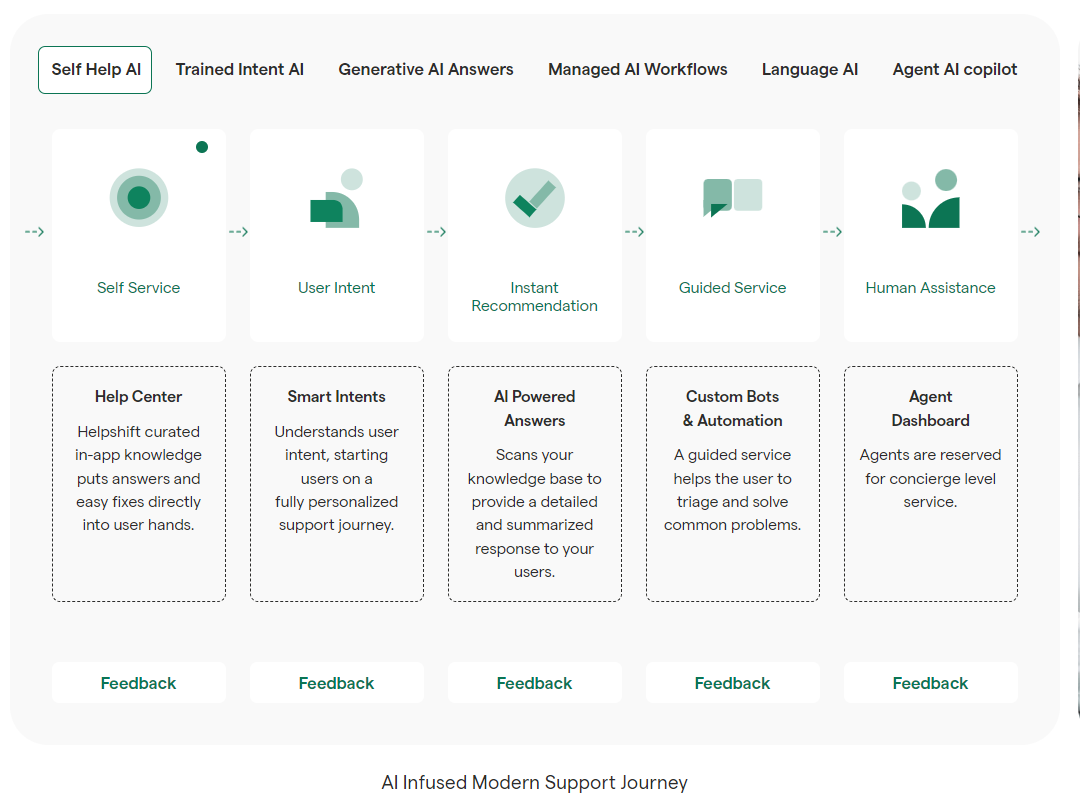
Helpshift enables agents to manage communications through a centralized dashboard that offers comprehensive insights into customer interactions and histories. Any agent can effortlessly continue a conversation without losing context or details.
Key Feature 1: AI Chatbots And Automation
Helpshift redefines instant, round-the-clock customer support through AI chatbots that can deliver near-human responses. Unlike traditional rule-based chatbots designed to follow predefined rules and scripts, Helpshift’s AI chatbots leverage advanced algorithms and natural language processing (NLP) capabilities.
These conversational AI chatbots can understand customer queries and provide real-time responses without human intervention. These chatbots learn from customer interactions and improve their accuracy over time, ensuring personalized responses. The chatbots are also backed by Helpshift’s Language AI, which enables the bot to understand and respond to customer queries in multiple languages.
Helpshift leverages generative AI to provide reliable answers directly from your knowledge base. Generative AI can adapt to new customer scenarios and comprehend more complex questions. However, it is prone to hallucinations and may provide misleading answers.
To address this, Helpshift utilizes the Retrieval-Augmented Generation (RAG) technique, powered by its Quick Search Bot, to improve the accuracy of answers generated by its AI responses. RAG allows transmitting additional information alongside the instructions in the Large Language Model (LLM) prompt, enabling more precise and dependable answers.
The system continuously learns from customer interactions to improve the answers provided, and in the event of complex issues, it can pass them on to a human agent.
Helpshift also offers a visual automation bot builder that tackles the issue of building and deploying modular workflows. Bots can be custom-designed to carry out custom tasks, verify customer information, or optimize search.
Key Feature 2: AI-enhanced Agent Workspace
Helpshift’s agent workspace connects human agents, bots, and workflows in a centralized workspace to boost agent productivity, reduce resolution times, and enhance collaboration.
The centralized operations workspace allows managers to monitor support operations and track performance metrics, tickets, and team activity in real-time. There is also an integrated messaging platform where agents can communicate with customers and other agents.
Helpshift’s Queue Management feature within the Agent Workspace streamlines ticket distribution with smart automation, ensuring a balanced workload across support agents and timely responses to customer inquiries. This works alongside the sentiment analysis AI, which detects high levels of customer dissatisfaction, and routes tickets to human agents without manual tagging or intervention.
The system’s Smart Auto-Assignment automatically directs incoming issues to the appropriate agent, optimizing issue resolution processes and reducing wait times. Protected Queues allow control over ticket access. You can determine which agents can view and respond to sensitive or complex issues, thus enhancing security.
Real-Time Operations Monitoring features enable managers to dynamically adjust resources as needed, ensuring that customer service remains high during peak times or as issues fluctuate.
Key Feature 3: AI-powered Intent Detection And Classification
When users initiate a conversation, Helpshift’s Smart Intent AI jumps into action to understand the customer’s issue and routes it to the support team or human agent for assistance.
Smart Intent AI automatically detects the context, language and sentiment of incoming tickets to intelligently triage customer queries, eliminating unnecessary processes and resolving issues faster.
The AI agent can also empower customers with dynamic menus, which are designed in real time based on the context of the customer’s queries.
Smart Intent AI is also pre-trained to understand issues specific to an industry and categorize incoming tickets. You can group similar requests and assign them to a support agent.
Key Feature 4: Multilingual Customer Support
Helpshift’s Language AI eliminates language barriers that could prevent businesses from providing an outstanding global customer service experience.
Unlike other customer service software that relies on Google Translate or costly language service add-ons, Helpshift utilizes proprietary machine learning translation, Language AI, to streamline communication between support agents and customers in their native language. This eliminates the need for third-party add-on services resulting in operational cost savings.
Custom-trained engines maintain brand-specific terminology to maintain consistency across languages. Machine-learning engines can be trained to understand and translate a company’s specific language so that the translated content maintains its intended meaning and brand voice across different languages.
Language AI also translates support articles in the Help Center with a single click, making it accessible to a global audience.
Key Feature 5: Self-Help AI And Knowledge Base
Helpshift’s Self-Help AI provides a smart knowledge base designed to enable self-serve experiences for customers. The centralized knowledge hub serves as a single source of truth for human agents, AI agents, and customers.
With Language AI, support articles in the Help Center can also be translated into multiple languages, eliminating the stress and costs of manual translation.
Pricing
- Starter plan: $150 per month.
- Growth plan: Customized based on your team’s needs
- Enterprise plan: Customized based on your team’s needs

Zendesk AI
Zendesk is a comprehensive customer service software that integrates advanced AI capabilities into its service offerings. These features support agent productivity, boost customer satisfaction, and improve efficiency. One of its key capabilities is an answer bot that automatically answers common customer inquiries by suggesting relevant knowledge base articles.
Zendesk AI targets medium- to large organizations’ customer service teams and support agents. This AI customer support software employs predictive analytics to anticipate and proactively address common customer queries. It also leverages multilingual support to handle customer inquiries from a diverse customer base.
However, this AI technology is not without its drawbacks. While Zendesk AI offers features like automated ticket routing and answer suggestions, it may struggle to handle complex customer queries. It may not effectively interpret nuanced language or situations requiring a deep understanding of the context.
Moreover, Zendesk has traditionally been best at offering workflow automations and its AI capabilities aren’t deeply integrated within the platform. Unlike Helpshift, its AI may not easily adapt in real time with user context and sentiment.
Read: How Sybo went from a 3.8 to 4.3 CSAT rating after switching to Helpshift from Zendesk
Key features
- Automation
- Predictive analytics
- Integration with Zendesk’s suite
Pricing
Basic plan starts at $55 per agent/month. Includes multiple plans.
Salesforce Einstein
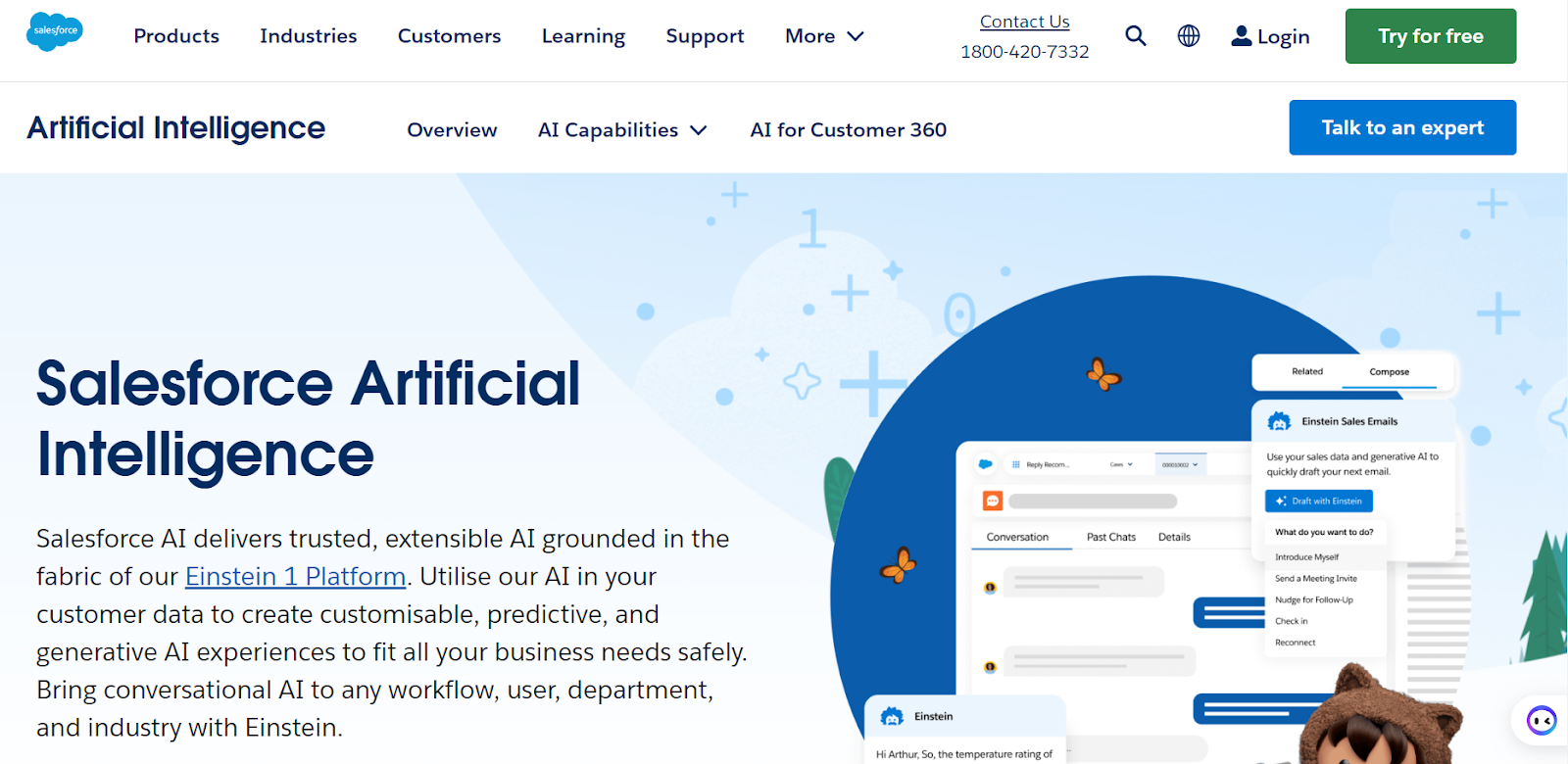
Salesforce Einstein is an integrated suite of AI technologies built into the Salesforce customer service platform. It enhances customer relationship management (CRM) by automating tasks and providing actionable insights. This is possible through Einstein Bots, AI-driven chatbots that handle customer queries and enhance customer interactions. With the Einstein Language APIs, businesses can tap into its image recognition and natural language processing (NLP) capabilities to analyze customer data.
Salesforce Einstein targets sales and marketing teams, customer service teams, and business analysts. Users can employ Einstein Bots and Case Classification features to automate routine tasks, reducing response time and increasing agent productivity. The prediction builder helps identify customers at the risk of churning so support agents can retain them through proactive support.
However, this AI customer service software can be complex for users without a strong technical background. Although this software offers valuable insights, it also uses customer data stored within Salesforce, raising concerns about data privacy and compliance.
Key features
- Predictive analytics
- Natural language processing
- Chatbots
Pricing
Starting from $50 per user/month
Intercom
Intercom is a customer messaging platform that combines self-service tools, automation, and messaging capabilities to enhance customer support. This AI customer service tool is designed to streamline customer service operations and improve customer interactions. Intercom’s Smart Campaigns automate messaging campaigns tailored to user behavior across their product journey.
This customer service software targets product managers, SaaS companies, sales and marketing teams, and customer support teams. It’s also a great tool for e-commerce businesses. Intercom leverages product tours to guide new users through onboarding, ensuring they understand all aspects of product usage. Users can also create automated workflows to anticipate customer issues and deliver relevant responses.
However, Intercom offers limited customization options as it may not be flexible enough to tailor to specific branding or workflows. Some users have also complained about slow response times from Intercom’s customer support team, which is quite ironic for customer support software.
Key features
- Conversational AI
- Automated workflows
- Personalized customer interactions
Pricing
Starts at $39/seat per month
Freshdesk AI

Freshdesk AI is part of the Freshworks suite, which leverages artificial intelligence to enhance customer service operations, automate repetitive tasks, and provide swift customer service solutions. A key AI-driven feature is Freddy AI, a suite of AI tools that includes voice bots, email bots, and chatbots to automate customer interactions. Freddy Insights also delivers actionable insights by analyzing customer feedback to identify patterns and areas for improvement.
This is aimed at small to medium-sized businesses, customer service managers, and e-commerce businesses. These target audiences can use Freddy AI chatbots to handle common customer queries, significantly reducing the pressure on human agents while meeting customer needs.
However, Freshdesk AI also has limited capabilities as it focuses on basic automation tasks such as sentiment analysis, answer suggestions and ticket routing. It may struggle with customer inquiries that require deeper natural language understanding. Customers have also encountered difficulties integrating Freshdesk AI with other workflows within their existing system.
Key features
- AI-driven ticketing system
- Sentiment analysis
- Help desk automation
Pricing
Offers a free plan. Includes the Pro plan at $48.99 per agent/month
Botpress
Botpress is an enterprise-grade AI agent platform for customer support that connects to Zendesk or Intercom, or runs as a standalone AI-native helpdesk. Unlike tools built only to deflect FAQs, it carries tickets through resolution, including refunds, account changes, and multi-step workflows that most AI tools escalate to a human.
Botpress is best for support teams that have already tried a first-generation AI tool and hit its ceiling. Most AI support tools were built by helpdesk companies that added AI later. Botpress was founded as an AI agent company in 2017 and built its helpdesk around that foundation, which is why it doesn’t hand off the moment a ticket gets complicated. If handoff is necessary, the human agent receives the AI agent’s full context and conversation history.
However, that depth is a tradeoff: teams wanting the simplest possible bolt-on may find a single-purpose deflection bot faster to turn on out of the box.
Key features
- Handles L1, L2, and L3 tickets with no technical ceiling
- Works on top of Zendesk/Intercom with no migration, or replaces them
- Hot handoff: full conversation history, live account data, and a summary of AI actions passed to human agents at escalation
- Conversation-based pricing, no per-seat cost
Pricing
Botpress has four plans: Free; Plus at $150/month; Team at $750/month; Enterprise at custom pricing. No per-seat fees.
LivePerson
LivePerson is a conversational AI customer support platform that enables businesses to connect seamlessly through automation and AI-driven chatbots. It leverages advanced AI technology to enhance customer engagement and sales. LivePerson uses LiveEngage, its comprehensive messaging platform, to integrate with various communication channels, including social media, mobile and web apps. Other capabilities include Agent Assist, sentiment analysis, AI analytics, and Bot Studio.
This works great for business leaders, financial institutions, sales and marketing teams, and customer support teams. Users can integrate LiveEngage to manage customer conversations across multiple channels, thereby providing a unified customer experience. The Intent manager helps to understand customer intent and route conversations to appropriate human agents.
However, LivePerson caters heavily to large enterprises, as smaller businesses may find its features and pricing overly complex for their needs. Some customers also find its reporting and analytics functionalities basic compared to competitors.
Key features
- Chatbot builder
- Omnichannel support
- AI-driven customer insights
Pricing
Starts at $40 per month.
Ada
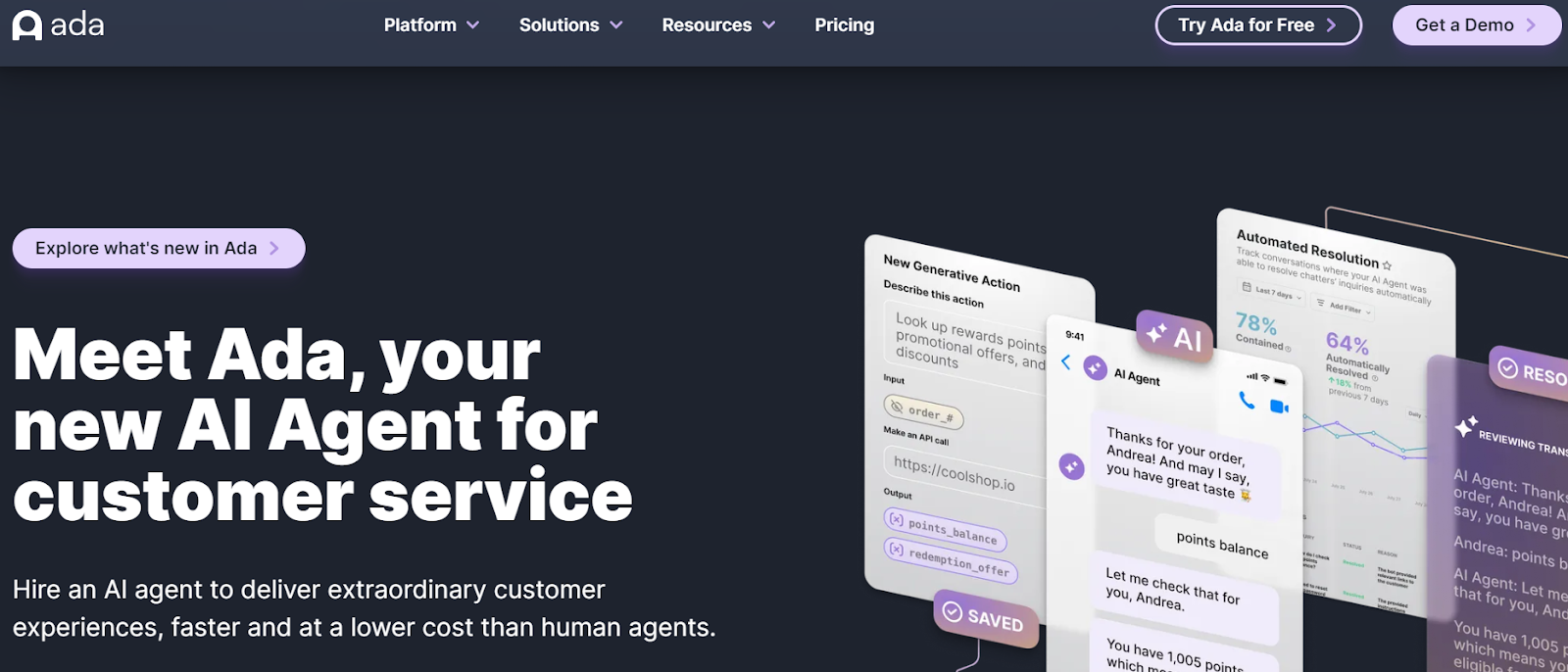
Ada is an AI customer service automation platform that leverages conversational AI to improve customer service and engagement. Therefore, it focuses on providing personalized and efficient customer interactions. Ada features an intuitive, no-code interface to create, test, and deploy chatbots and automate workflows. It also includes tools to send automated messages based on customer behavior to boost customer satisfaction.
Therefore, this works great for SaaS companies, support teams, and e-commerce businesses. Users can deploy AI chatbots to handle common customer questions, freeing up human agents to work on complex issues. It also includes self-service tools that empower customers to resolve issues independently through user-friendly chatbot interactions.
However, Ada’s no-code approach means deeply custom or highly technical workflows can hit a ceiling, and teams needing granular control over resolution logic may find it limiting compared to platforms built for complex, multi-step cases.
Key features
- Personalized interactions
- Multilingual support
- No-code chatbot builder
Pricing
Custom pricing
Drift

Drift is a conversational customer service software that focuses on marketing and sales. It is designed to boost customer engagement and generate leads using AI chatbots and automation. Drift leverages conversational AI through intelligent chatbots that increase customer satisfaction. It also includes the Drift Playbooks, a pre-built conversational workflow designed to guide visitors through different user journey stages. Drift also integrates with CRM systems for better customer service interactions.
This can be used mostly by customer support agents, B2B companies and large enterprises. Businesses can increase the effectiveness of their marketing efforts by leveraging AI customer service tools to tailor interactions based on user behavior. It also utilizes data obtained from analyzing customer sentiment to identify trends and refine strategies for better outcomes.
Although Drift has a sleek and user-friendly interface, the backend interface for administrators can be overly simplistic. This makes it challenging to manage automation and complex workflows effectively. Drift also prioritizes lead generation through chatbots and website interactions, which is inconvenient for businesses that need robust ticketing functionalities and a comprehensive help desk experience.
Key features
- AI chatbots
- Real-time engagement
- Conversation analysis
Pricing
Starts at $600 per month for 10 seats. Additional seats at $80/month.
Tidio
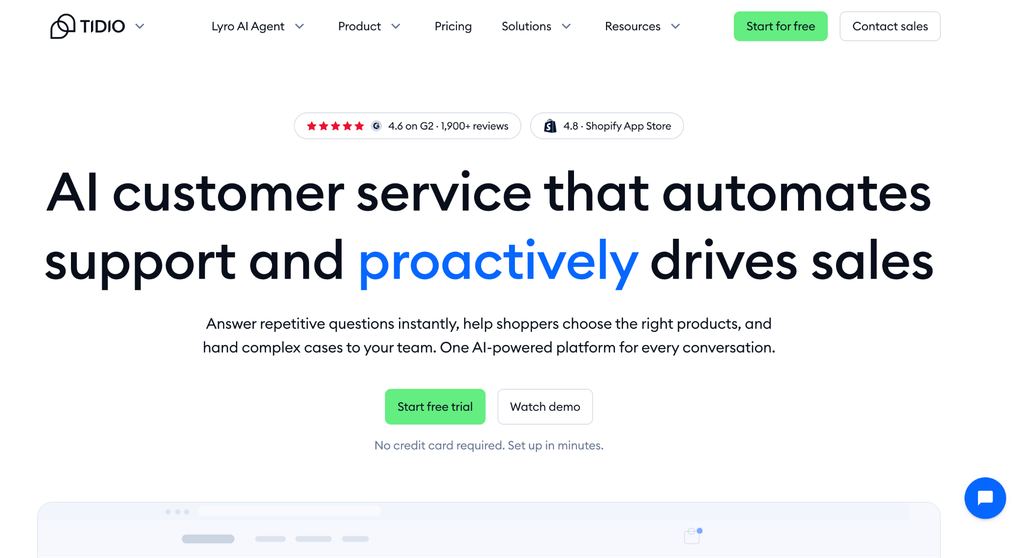
Tidio is an AI customer service platform that helps businesses communicate with their customers using live chat, email marketing, chatbots, and social media. It also provides users with detailed analytics on how their customers interact with the websites.
Tidio is best suited for ecommerce stores, small to medium-sized businesses, and online brands that want to automate routine support and sales tasks. Lyro, its AI agent, handles common customer questions, recommends products, provides order updates, and qualifies leads, giving human agents more time to focus on complex issues and high-priority inquiries.
However, teams should account for separate usage limits for human conversations, Lyro AI conversations, and Flows. The first 50 Lyro conversations are a one-time allowance and ongoing AI automation requires a paid conversation quota.
Key features
- Easy setup with a Shopify/WordPress live chat plugin
- Lyro, a conversational AI capable of automating up to 75% of conversations
- Customizable chat widget and pre-chat surveys
- Canned responses, automated messages, and chatbot templates
Pricing
Offers a free plan. Paid customer service plans start at $29/month, or $24.17/month billed annually.
Bold360

Bold360 (now Genesys DX) is an AI digital engagement solution designed to improve customer satisfaction and retention. It integrates with various communication channels to understand and attend to customer needs. Bold360 also offers detailed analytics and reporting to boost agent efficiency.
This customer service software is tailored toward e-commerce businesses, large enterprises, healthcare providers and customer support teams. Bold360 uses natural language processing and relevant customer data to deliver instant support. It also leverages AI to provide knowledge base articles and self-service support.
However, Bold360’s pricing can be complex and expensive for smaller businesses. The limited transparency surrounding pricing tiers can also make budgeting challenging. Meanwhile, some customers have encountered slow response times with Bold360’s customer support team, which can be frustrating when needing assistance.
Key features
- Improved analytics
- Self-service tools
- AI live chat
Pricing
Custom pricing
Watson Assistant (IBM)

This advanced AI virtual assistant is designed to enhance customer experience and engagement using natural language understanding and machine learning. It uses machine learning to continuously improve responses and overall customer support experience.
This works great for IT helpdesks and marketing teams. Watson Assistant can help users engage potential customers and guide them through the buying process, enhancing conversion rates. Its IT Helpdesk provides instant support for IT-related issues and ticket creation, improving agent efficiency.
Although Watson Assistant boasts powerful features, implementing them successfully can be challenging for users without a technical background. Training Watson Assistant can be time-consuming for smaller teams with limited resources, as it requires dedication to ensure accurate responses. Some customers have also pointed out the somewhat generic conversations on basic templates, which can’t handle nuanced customer inquiries.
Key features
- AI training tools
- Advanced natural language processing
- Integration with various platforms
Pricing
Starts at $140/month
How to Stop Answering the Same Questions Over and Over
If your agents spend most of their time on repeat questions, the fix is not more headcount, it is automating the repetitive layer so people only touch the exceptions. Four steps get you there.
1. Find your top repetitive intents. Pull your last quarter of tickets and rank them by volume. In most support operations a small number of intents (password resets, order status, refunds, how-to questions) make up the bulk of the queue.
2. Automate those intents end to end. Point an AI agent at the top intents so it resolves them fully, not just deflects them to an article. The difference between a platform that answers and one that resolves is the difference between a lower queue and a lower cost.
3. Route the rest with context. Intent detection should classify what is left and send it to the right human agent with the conversation, history, and sentiment attached, so nothing starts from zero.
4. Measure resolution, not just deflection. Track automated resolution rate and repeat-contact rate together. A high deflection number with high repeat contacts means customers are giving up, not getting helped.
This is what an AI-native platform is built to do. Helpshift’s Care AI agent resolves the repetitive majority of tickets automatically and escalates the rest, and the AI Copilot shortens the ones that do reach a person.
The Top Conversational AI Platforms for Customer Support
Conversational AI is the layer that lets customers get answers in natural language instead of navigating a menu. Among the platforms above, the strongest conversational AI options are Helpshift (intent detection plus RAG-grounded answers with escalation), Intercom’s Fin, Ada (no-code, multilingual), and LivePerson (enterprise messaging). The right pick depends on where your customers already are and how much you need the AI to resolve rather than just chat. For a deeper look at this category on its own, see our guide to conversational AI platforms.
How to choose the right AI customer service software platform
Businesses must consider various factors when choosing the right software from numerous AI customer service software. Here are some to help you pick the best solution.
Understand your software needs
What tools does your business need that will help you better engage with your customers? Understanding your software needs is crucial to choosing the right customer service software.
Consider your budget
Check to ensure the software has a transparent pricing strategy with no hidden costs. Implementing AI in your customer service strategy starts with choosing one that is reasonable for your business.
Data security
How well does your AI customer service software protect user data? Data security is important because you must ensure that the customer service AI tool doesn’t compromise your customer data.
Ease of integration
Businesses leverage numerous tools to ease customer interactions. The right customer service software should integrate seamlessly with these tools to streamline customer conversations.
Scalability
As your business grows, so should your AI customer service software. Choose one that can accommodate your evolving needs without issues.
FAQs
Is automated customer service important?
Integrating automated customer service into your business processes can improve your workflow. Although this is a decision each business must make for itself, introducing AI and chatbots can help to manage customer demands effectively.
What is the best AI customer service software?
Although there are numerous AI customer service solutions, Helpshift stands out as an all-around customer support software that reduces churn, builds customer relationships and helps generate revenue. Its unique features are tailored to help businesses get the most out of customer interactions while boosting the productivity of customer service agents.
How can my business leverage AI customer service tools?
Businesses can leverage AI customer service tools in different ways. This can help deliver customer service at its best, including answering FAQs without human intervention, automating email responses, analyzing customer sentiment and offering proactive support.
What are the best customer support automation platforms?
The strongest customer support automation platforms in 2026 are Helpshift, Zendesk AI, Intercom’s Fin, Freshdesk Freddy, Botpress, and Ada. Judge them on how much they actually automate: deflection of repetitive tickets, intent detection and routing, end-to-end resolution rather than FAQ deflection, and clean handoff to a human agent. Helpshift leads for AI-native, high-volume, and in-product support; the others fit specific stacks and budgets.
What are the top conversational AI platforms for customer support?
The leading conversational AI platforms for support are Helpshift, Intercom’s Fin, Ada, and LivePerson. Helpshift pairs conversational AI with intent detection and retrieval-grounded answers so it resolves issues rather than only chatting, Intercom’s Fin suits chat-first teams, Ada offers no-code multilingual automation, and LivePerson fits enterprise messaging at scale.
What is the best customer support software for SaaS apps?
For SaaS, the best fit depends on volume and where support happens. Intercom suits chat-first, in-product messaging, Zendesk fits larger teams needing a broad ecosystem, and Freshdesk works for budget-conscious SMBs. For SaaS products with high volume or in-app support needs, Helpshift’s AI-native automation and in-product SDK resolve the repetitive majority without adding agents.
Our agents spend most of their time answering the same questions. How do we fix this?
Automate the repetitive layer. Rank your tickets by intent, point an AI agent at the highest-volume ones so it resolves them end to end, and route what is left to a human agent with full context attached. Then measure automated resolution rate and repeat-contact rate together, so you are tracking whether customers were actually helped, not just deflected. An AI-native platform like Helpshift is built to resolve the repetitive majority automatically.
What is the best customer support software today?
There is no single best for every team, but for AI-native automation with clean human escalation, Helpshift stands out, especially for high-volume and in-product support. Zendesk leads for large teams on its ecosystem, Intercom for chat-first SaaS, and Freshdesk for budget-conscious SMBs. Match the platform to your volume, your channels, and how much you need the AI to resolve rather than route.
What tools and platforms do CX agents use today?
Modern CX teams combine several layers: an AI agent for autonomous resolution, an agent copilot for summaries and suggested replies, a ticketing and workspace layer, a knowledge base for self-service, and analytics for quality and sentiment. Platforms like Helpshift, Zendesk, Intercom, and Freshdesk bundle these to different depths, so most teams standardize on one platform that covers automation, agent assist, and analytics together.
The Bottom Line
The platform that wins is the one that clears your queue, not the one with the longest feature list. Rank your tickets by intent, look at how much of that volume each platform can resolve on its own, and check what happens at the handoff. A tool that deflects a repeat question into a help article moves the number without helping the customer.
For teams facing high volume and in-product support, Helpshift resolves the repetitive majority automatically, detects intent and sentiment before routing, and passes the rest to a human agent with full context. Bring your highest-volume ticket types and see what autonomous resolution looks like on your own queue. Request a Helpshift demo.