
Most platform comparisons start with a feature table. This one starts with a question worth answering first: what was the platform actually built for?
Zendesk has been in the market since 2007. It powers support operations across e-commerce, SaaS, healthcare, and a range of other industries. That breadth is its strength — and its constraint. When a gaming studio evaluates Zendesk, they are looking at a platform built for every context and optimised for none in particular.
Helpshift was built for gaming from day one — specifically for mobile and live-service titles, where pulling a player out of the game to raise a support query is a retention event, not just an inconvenience. Fourteen years of proprietary gaming data sit behind its AI models. Its SDK lives inside the game, not alongside it.
That difference shapes the AI accuracy, the pricing model, the solutions available, and the results studios report. This comparison works through the dimensions that matter for gaming operations — including where Zendesk holds its own.
Helpshift vs Zendesk: Overview
Helpshift
Helpshift is the AI-Native Player Engagement Platform, a Keywords Studios company that combines technology, AI, and human services into a single ecosystem. The platform runs four integrated solutions: Support, Engagement, Trust and Safety, and Community.
The native in-game SDK means players never have to leave the game. Behind the automation sits a global team of gaming-specialist agents with over 25 years of Keywords Studios expertise across the industry. Compliance covers SOC2, ISO 27001, GDPR, COPPA, and HIPAA.
Zendesk
Zendesk offers a range of business software solutions, with customer service as one facet. While its omnichannel tools and varied pricing plans suggest versatility, it’s inadvertently designed to cater more to larger brands. Many critical features, such as automation, analytics and support, are only available in its suite plan, leaving lesser plan users with no choice but to upgrade or settle for bare minimum.
Although Zendesk has integrated AI and automation tools to enhance its offerings, these technologies are not intrinsic to its design. Hence, achieving a high-end experience across different platforms would necessitate additional development efforts and integration with external tools.
Helpshift: A Gaming-First Zendesk Alternative
Helpshift is a gaming-first Zendesk alternative, the AI-native player engagement platform built for mobile and live-service titles rather than adapted from general business software. Zendesk routes players out to web forms and email to raise a query. Helpshift keeps support inside the game through a native SDK, so players never break the session to get help.
The deeper difference is scope. Zendesk covers support. Helpshift runs support, engagement, trust and safety, and community as one platform on shared data, so a studio manages the full player relationship in one place instead of assembling third-party tools around a support-only core.
At the center sits Care AI, Helpshift’s flagship agentic AI agent, which resolves 70%+ of player conversations autonomously, in-game and around the clock, then hands off cleanly to a human gaming specialist when a case should not proceed alone. Behind the AI is 25+ years of Keywords Studios gaming expertise and a global human services team.
What makes Helpshift a strong Zendesk alternative for gaming:
- Native in-game SDK, so players get help without leaving the session
- Care AI resolves 70%+ of player conversations autonomously
- Four solutions in one platform: Support, Engagement, Trust & Safety, and Community
- Proactive engagement that flags churn risk and VIP players before they disengage
- Gaming-grade compliance: SOC 2, ISO 27001, GDPR, COPPA, and HIPAA
Studios including SYBO, Kixeye, KRAFTON, and EA run on Helpshift because the platform was built for what live-service gaming actually requires.
Helpshift vs Zendesk: Side-by-Side Comparison Table
Here’s a table showing the differences between Helpshift and Zendesk.
Side-by-Side: Key Dimensions for Gaming Studios
The table below focuses on what matters most for live-service mobile and PC titles. Both platforms are assessed against their current Q1 2026 capabilities.
| Dimension | Helpshift | Zendesk | Edge |
|---|---|---|---|
| AI and Automation | |||
| In-game support | Native in-game SDK Players raise issues without leaving the game. Device state, game version, and session metadata are captured automatically before the first message. Push notifications are a single toggle. Console and Discord supported natively. | Web forms and email — primary channels Zendesk’s own documentation routes gaming queries through web forms and email, requiring players to exit the session entirely. Push notifications require Webhook API configuration. No native in-game SDK. | Helpshift |
| AI intent detection | ~95% via Smart Intent Trained on 14+ years of proprietary gaming interaction data. Classifies player intent with gaming-specific context, not generic support vocabulary. The accuracy level directly determines autonomous resolution rates. | ~60% (Zendesk AI) Competent for general CX workflows. Not trained on gaming-specific terminology or live-service player behaviour patterns. A 35-point accuracy gap that compounds significantly at scale. | Helpshift |
| Purpose-built AI agents | 4 dedicated agents Care AI — autonomous resolution (70%+). Engage AI — churn prediction and VIP outreach. Guard AI — real-time QA across AI and human conversations. Lens AI — community sentiment across Discord, Steam, and app stores. | 2 tiers — Essential (bundled) and Advanced (add-on) AI assembled through acquisitions (Ultimate.ai, Cleverly, Klaus). Generative replies drawn from the knowledge base. No equivalent engagement, trust and safety, or community AI layer for gaming workflows. | Helpshift |
| Language and Localisation | |||
| Multilingual AI | 180+ languages, gaming-trained Proprietary Language AI custom-trained for branded gaming terminology and regional player vocabulary. Backed by 24/7 managed human specialist coverage in 150+ languages through Keywords Studios — the only platform combining gaming-trained AI with a managed human services layer at this scale. | Advanced: 80+ languages — Copilot: 16 languages ($50/agent/month) A meaningful capability improvement acknowledged in 2025–26. General-purpose language models without gaming vocabulary training. AI Copilot language support is an add-on tier. No equivalent managed human services layer. | Helpshift |
| Analytics, QA and Reporting | |||
| QA monitoring | Guard AI — included on all plans Real-time monitoring across both AI and human conversations simultaneously. Flags tone violations and brand guideline breaches as they occur — not in a post-conversation audit. No additional cost on any plan. | Klaus AI — $35/agent/month add-on A capable standalone QA product sold separately. For a 50-agent team, that is $1,750/month before Copilot or WFM. Operates as post-conversation review rather than real-time monitoring. | Helpshift |
| Reporting and analytics | Unified platform — available on all plans Support, QA, engagement, and community data sit in one reporting layer. No third-party tools required for cross-channel analysis. Available at every plan tier without additional configuration. | Zendesk Explore — fragmented cross-channel view Dataset restrictions apply on lower plans. Cross-channel analysis requires third-party integration. QA and workforce management data are separate tools, creating siloed player insights with no single source of truth. | Helpshift |
| Pricing and Total Cost of Ownership | |||
| Platform Ecosystem | |||
| VIP engagement | Engage AI and VIP Account Managers Churn signals trigger proactive outreach before high-spend players disengage. Dedicated VIP Account Managers with a sub-2-hour response SLA for flagged high-value players. | No equivalent No proactive engagement layer, no churn prediction, and no dedicated account management for high-value player segments. Support is reactive by design. | Helpshift |
| Trust and Safety | Guard AI and Superhero Moderators Real-time toxicity detection, DSA and COPPA compliance monitoring, and a dedicated human moderation escalation layer built to handle community safety at live-event scale. | No equivalent No dedicated Trust and Safety solution. Community moderation requires third-party tools. Gaming-specific regulatory compliance monitoring is not built natively into the platform. | Helpshift |
| Community management | Lens AI and Community Managers Native Discord integration for community support and moderation. Lens AI surfaces sentiment trends across Discord, Steam, and app stores, available to both support and community teams in the same platform. | No equivalent Discord integration requires third-party apps. No community sentiment monitoring layer. Steam and app store coverage is not native to the platform. | Helpshift |
| Compliance and Customisation | |||
| Dashboard customisation | Unlimited views with folder grouping No ceiling on shared or personal views. Teams organise queues by game title, region, VIP tier, or issue type without hitting plan-level restrictions. | Highly customisable — shared views capped at 12 Personal views capped at 8. Flexible for most operations but creates constraints for larger multi-title teams without paid add-ons or custom development. | Tie |
| Compliance | SOC2, ISO 27001, GDPR, COPPA, HIPAA Full gaming-relevant compliance stack. COPPA is critical for studios with under-13 player demographics. HIPAA for titles in adjacent health and wellness markets. | SOC2, ISO 27001, GDPR, FedRAMP Strong enterprise compliance posture. FedRAMP relevant for government procurement contexts. COPPA certification is not natively included — notable for gaming studios with younger audiences. | Tie |

8 Feature Areas: How the Platforms Actually Compare
1. In-App Customer Support: Zendesk vs Helpshift
This is where the platforms diverge most fundamentally, and it is not a feature difference, it is a design philosophy difference.
Zendesk routes gaming interactions primarily through web forms and email. Zendesk’s own documentation reflects this approach. Players exit the game, switch context, and re-explain their situation from scratch. Push notifications require Webhook API configuration. The experience works for industries where support happens outside the product. Gaming is not one of them.
Helpshift’s SDK sits inside the game. Players access support within their session. Metadata, device, game version, session state, is captured automatically before the first message arrives. Push notifications are a toggle. In-game CSAT across the Helpshift platform averages 3.8, the highest consistently reported in gaming. Helpshift’s benchmark data shows that players who are forced to leave the app to seek help churn within 30 days at a 90% rate.
That number is not a feature edge. It is the core argument for why in-game support is an architecture decision, not a configuration one.
2. Bots Automation and AI: Zendesk vs Helpshift
Zendesk has meaningfully improved its AI in 2025. Essential AI is bundled; Advanced AI is available as a paid upgrade. The platform generates AI replies from the knowledge base and handles general intent classification well enough for non-gaming workflows. That is a fair assessment of where it sits.
The gap shows up in the specifics. Zendesk classifies player intent at roughly 60%. Helpshift’s Smart Intent runs at 95%. That 35-point difference is not marginal, it determines how many queries resolve without a human, and how much of your agent queue is filled with cases that should never have escalated.
Helpshift runs three additional purpose-built agents alongside Care AI. Engage AI watches for churn signals and triggers proactive outreach to high-value players before they disengage. Guard AI monitors conversations in real time, AI and human, flagging tone and brand violations as they happen. Lens AI tracks sentiment across Discord, Steam, and app stores, giving support and community teams a shared view of player health.
Here’s what one of our customers has to say about our AI and bot capabilities:
“The Al bots! Al bots are not a unique idea, but the way Helpdesk has implemented them has been exceptional. I have worked on various platforms that provided Al bots, but the experience was not quite fascinating. The Al bot installed in the software is very trained and helps the customer with their exact query and thus helps eliminate a lot of repetitive questions a Representative has to face.”
3. Multilingual Support: Zendesk vs Helpshift
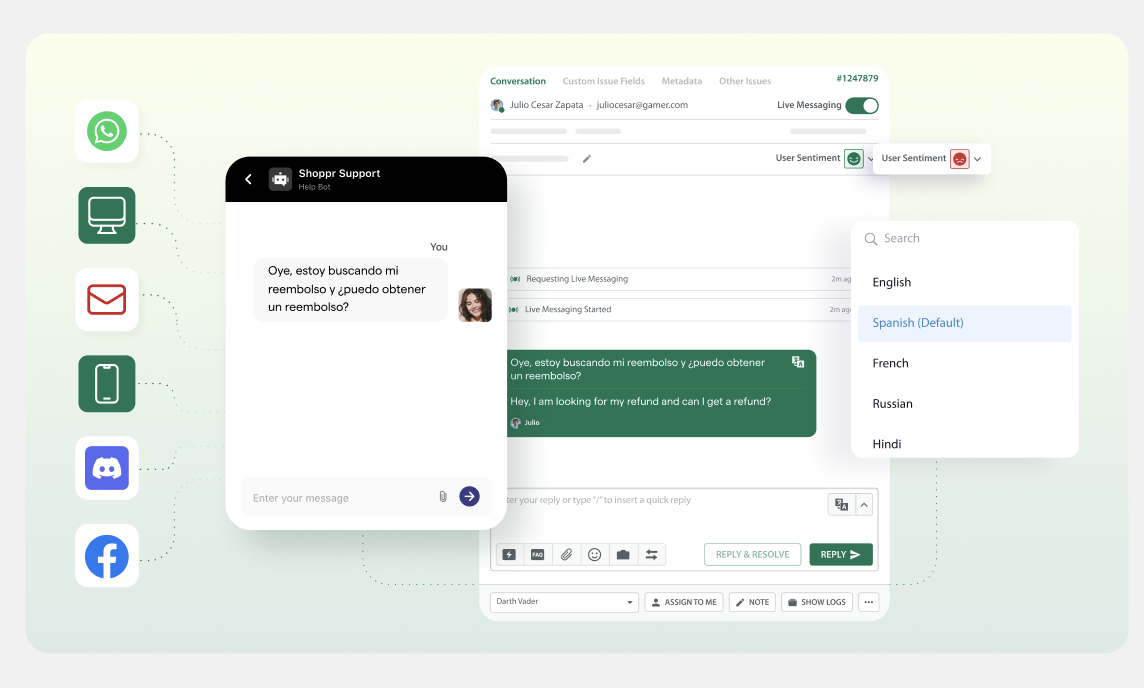
Zendesk Advanced AI now supports 80+ languages, a material improvement worth acknowledging. AI Copilot, its agent-assist layer, covers 16 languages at $50/agent/month as an add-on. The language models perform well for general-purpose translation but are not trained on gaming-specific vocabulary, regional player slang, or branded event terminology.
Helpshift’s Language AI covers 180+ languages with custom training for gaming terminology. Behind the AI sits 24/7 human coverage in 150+ languages from Keywords Studios gaming specialists. That combination, gaming-trained AI plus managed human services at global scale, has no direct equivalent in the market. When a live event launches in Southeast Asia and your AI misreads regional shorthand, the result shows up in your CSAT within the first two weeks.
4. Analytics and Reporting: Zendesk vs Helpshift
Zendesk’s analytics run through Zendesk Explore, a separate product that requires third-party tooling to cross-analyse channels. Dataset restrictions apply on lower plans. QA monitoring through Klaus is a further $35/agent/month. The practical result is that player data sits across multiple disconnected tools with no unified view of support performance, quality, and engagement in one place.
Helpshift surfaces support analytics, Guard AI QA data, engagement metrics, and community sentiment in a single platform, included across all plans, without additional cost for quality monitoring. For a VP of CX connecting support performance to player LTV outcomes, that unification changes what is possible in a weekly or monthly review. The data is already in one place rather than assembled across exports.
5. Ticket Management System: Zendesk vs Helpshift
Zendesk caps shared views at 12 and personal views at 8, a hard platform limit that affects larger operations managing multiple game titles, regional queues, or VIP segments. Working around those limits requires paid add-ons or custom development.
Helpshift offers unlimited views with folder grouping. Teams structure queues by game, region, VIP tier, or issue type without any ceiling. Combined with the unified Agent Workspace, which surfaces all player context, conversation history, and game metadata in one view, agents handle interactions with less context-switching and fewer unnecessary escalations.
6. Approach to Customer Service: Zendesk vs Helpshift
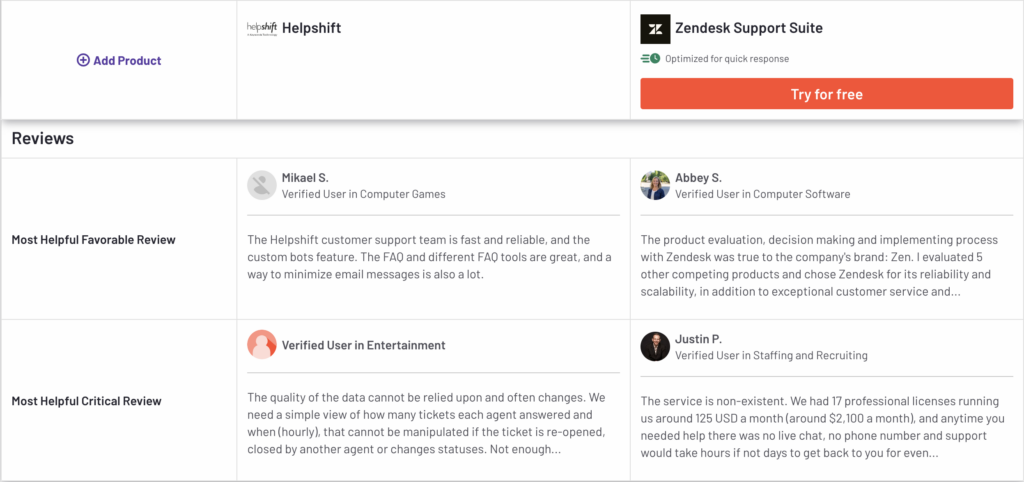
Zendesk has a documented reputation for support that does not match what it sells. Slow escalation paths, ticket-based handling for a ticketing platform’s own customers, and inconsistent response times across plan tiers are widely referenced in third-party reviews. That is not a competitive talking point, it is a pattern worth raising as a due-diligence consideration.
Helpshift provides dedicated success managers and a structured onboarding process. Kixeye, a Stilfront studio, completed a full Zendesk-to-Helpshift migration in 12 weeks. That timeline speaks directly to the most common objection studios raise about switching: migration complexity and operational risk. The 12-week precedent removes that objection as a blocker.
One frustrated user said this:
“Zendesk support is non-existent, which is ironic. We have been unable to use the product for 60 days due to SMS delivery issues, over 90% of our SMS get rejected. And they won’t help, call us, or support us in any way. STAY AWAY — the worst support I’ve ever encountered.”
This suggests that Zendesk’s challenges are not limited to the functionality of its software but extend to the very core of customer service.
In contraction, Helpshift offers various layers of support across different plans, from comprehensive articles to personalized assistance. Here’s a brief testimonial from one of our satisfied customers:
“The Helpshift customer support team is fast and reliable”
Now, the choice is yours: will you trust a brand that struggles to help itself with its product or one backed by overwhelming evidence of its capabilities?
7. Pricing: Zendesk vs Helpshift
Zendesk’s per-seat pricing looks manageable at the headline level. Suite Professional starts at $115/agent/month. The real number assembles across add-ons: AI Copilot at $50, Zendesk QA at $35, Workforce Management at $25. Bot resolution is charged at $1 per resolved issue on lower plans. A 50-agent team on Suite Professional and Copilot alone reaches $8,250/month before QA, WFM, or implementation overhead. The total cost of the platform is rarely visible in the initial evaluation.
8. Gaming Support: Zendesk vs Helpshift
Zendesk covers support. For studios running live-service titles in 2026, support is one quarter of what player engagement actually requires operationally.
The player relationship runs across in-game support, proactive VIP retention, community health monitoring, and real-time trust and safety moderation. Those are four distinct operational challenges. Zendesk addresses one of them with a single tool and a set of third-party integrations for the rest. Helpshift addresses all four with integrated solutions, Support, Engagement, Trust and Safety, and Community, backed by both AI and human specialists across each area.
Here’s what one of our gaming customers had to say:
“Very focused solution for gaming companies looking for an SDK integration. The bot flows are very helpful in proactively addressing user concerns”
In contrast, Zendesk lacks specificity for the gaming industry, lacking native mobile support, Discord, and console integrations.

Which Platform Fits Your Studio?
The right answer depends on what your operation actually needs. Helpshift is the clear choice for live-service gaming. But the evaluation should be honest on both sides.
| Helpshift tends to be the right fit when… | Zendesk may make more sense if… |
|---|---|
| You run a live-service mobile or PC title and need support native to the game. | You are a non-gaming SaaS, e-commerce, or healthcare brand. |
| Zendesk’s per-seat model is becoming unpredictable as your agent count grows. | You are a small indie studio with a handful of agents and basic ticket flows. |
| You need proactive, differentiated support for VIP and high-spend players. | You have recently renewed your Zendesk contract and migration timing is off. |
| DSA, COPPA, or community toxicity is a live compliance and brand risk. | Your operation is heavily telephony-dependent as a primary support channel. |
| You want support, engagement, moderation, and community in one platform. | You are deeply embedded in the existing Zendesk ecosystem and integrations. |
| You are planning a Zendesk migration. Kixeye completed one in 12 weeks. |
See What Helpshift Delivers for Your Studio
Zendesk handles support. That is a genuine capability for a broad range of industries. But gaming studios operating live-service titles in 2026 do not need a general support platform with gaming bolted on, they need a platform where gaming is the foundation, not the use case.
The player relationship does not begin and end with a resolved query. It includes how a high-spend player is engaged before they churn, how a toxicity incident is caught before it escalates publicly, how community sentiment shifts after a live event, and whether the AI handling your support volume actually understands what your players are asking.
Helpshift was built for all of that, not as separate tools you integrate, but as one platform connecting support, engagement, trust and safety, and community through shared data and AI models trained on 14+ years of gaming interactions.
Studios including SYBO, Kixeye, KRAFTON, and EA chose Helpshift because the platform was built for what gaming studios actually require. If that is the evaluation you are running, the next step is seeing the platform in practice.
Helpshift vs Zendesk: FAQs
Who requires Zendesk?
Zendesk appeals to businesses that need customer support for a specific channel like support, guide, talk, or chat or are willing to integrate them with add-ons.
Why do businesses look for Zendesk alternatives?
Zendesk is hardly usable without add-ons, it provides terrible customer support and lacks sophisticated AI and automation technologies.
Why do businesses choose Helpshift over Zendesk?
Helpshift stands out with its slew of AI features that enable businesses to automate 70% of customer queries freeing up their support reps to prioritize high priority tickets. Features such as Intent AI, Multilingual AI, conversational chatbots, and AI powered answers, ensure users find answers quickly without human intervention.
Read more: Zendesk Alternatives
What Users Say About Helpshift vs Zendesk? : (according to G2)
Know Why Rovio switched to Helpshift: