


Intercom is one of the most widely deployed customer support platforms on the market, and in 2026 it rebranded around its AI agent, now operating as Fin. Helpshift is the AI-native player engagement platform built specifically for gaming studios. Both compete for the support budget inside a game studio, but they answer different questions.
Intercom (Fin) asks how to add a capable AI agent to the helpdesk you already run, for any industry. Helpshift asks how to resolve issues unique to players within the game itself, backed by gaming-specialist humans, when AI should not handle them alone.
This guide compares Helpshift and Intercom across pricing, AI resolution quality, in-game integration, analytics, and setup, then covers when each platform is the stronger fit.
Helpshift vs Intercom at a Glance
| Attribute | Helpshift | Intercom (Fin) |
| Best for | Gaming studios, omnichannel player support | General B2B/B2C support teams, SaaS and ecommerce |
| AI type | Agentic (Care AI) | Agentic (Fin AI Engine) |
| In-game support | Native SDK ✓ (mobile, PC, web, console) | No native in-game SDK |
| Gaming context | 25+ yrs gaming expertise ✓ | Generic, cross-industry |
| Pricing model | Custom, usage-based | Seat tiers + $0.99 per resolution outcome |
| Setup timeline | ~10 days via Keywords Studios | 1–3 days self-serve; longer for complex integrations |
What Is Helpshift?
Helpshift is the AI-native player engagement platform by Keywords Studios. It combines technology that natively enhances the in-game experience, AI that scales, and human gaming specialists who deliver strategic value. A native in-game SDK keeps players in-game rather than routing them to a web portal, and the platform spans four solutions across the player lifecycle: Support, Engagement, Trust and Safety, and Community.
Its flagship agentic AI, Care AI, resolves 70%+ of player conversations autonomously, with proactive outreach, guardrails, community sentiment, and 75+ language coverage delivered as capabilities underneath it. Gaming-specialist human agents handle escalations that require judgment. Helpshift supports 500+ game studios and powers 2bn+ devices, backed by 25+ years of gaming expertise.
What Is Intercom?
Intercom was founded in 2011 as a messaging and helpdesk platform and became one of the most recognized names in B2B customer support. In May 2026, the company rebranded itself around its AI agent product and now operates as Fin, though most buyers still search for it as Intercom.
In June 2026, Salesforce signed a definitive agreement to acquire Fin for approximately $3.6 billion; as of this writing, the deal is signed but not closed, with completion expected in Salesforce’s fiscal Q4 2027 pending regulatory approval. Fin serves more than 30,000 companies across SaaS, ecommerce, fintech, and other industries, with an AI agent that resolves an average of 76% of support volume end to end.
Intercom vs Helpshift: Feature Comparison
Feature lists for both platforms look similar until you check them against a live-service title. Here’s how the two platforms compare across in-game delivery, AI agent capability, human escalation, safety, and language coverage:
1. Automation and AI Quality
Care AI is Helpshift’s agentic AI agent. It reasons through a player’s goal, plans multi-step actions, and resolves issues autonomously, in-game, using four configuration layers: Personality, Knowledge, Procedures, and Guidelines. It resolves over 70% of player conversations autonomously and is built for gaming-specific intents from the ground up, including missing rewards, entitlement sync, ban appeals, and account recovery.
Fin’s AI Engine uses purpose-built retrieval and reranking models rather than a generic LLM wrapper, and Fin reports an average resolution rate around 76% across its customer base, with a hallucination rate cited near 0.1% at scale.
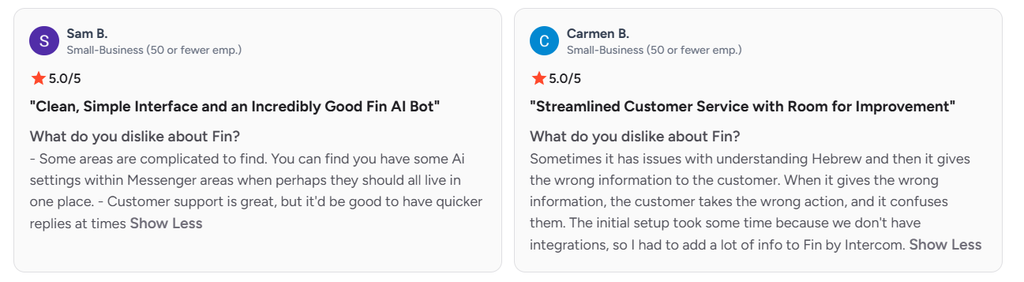
That is a strong, well-proven result, and Fin holds ISO 42001 certification for AI governance, one of the first support platforms to do so. However, Fin lacks custom offerings for gaming studios. Fin’s models are trained on general support conversations across every industry it serves. It doesn’t specifically focus on the ban-appeal, LiveOps, and in-app-purchase patterns that make up most gaming ticket volume.
2. Omnichannel and In-Game Integration
Helpshift’s in-game SDK runs natively across iOS, Android, Unity, Unreal, web, PC, and console, with a patented QR-code handoff that moves a stuck console player to mobile without losing game or account context. Support never pulls the player out of the session.
Fin’s channel coverage is broad. It consists of chat, email, voice (Fin Voice), SMS, Slack, WhatsApp, and Discord, which, according to fin.ai’s own comparison, has the widest channel spread among AI-native agents. Discord is supported as a messaging channel, but there is no native in-game SDK or console-specific handoff, so a console player still has to leave the game to reach support.
3. Analytics and Player Intelligence
Helpshift’s Care AI ships a native Care AI Agent Analytics dashboard with metrics such as Issues Resolved, CSAT, Time to Resolve, Time to First Response, Reopen Rate, and Issue Touches, all included regardless of tier.
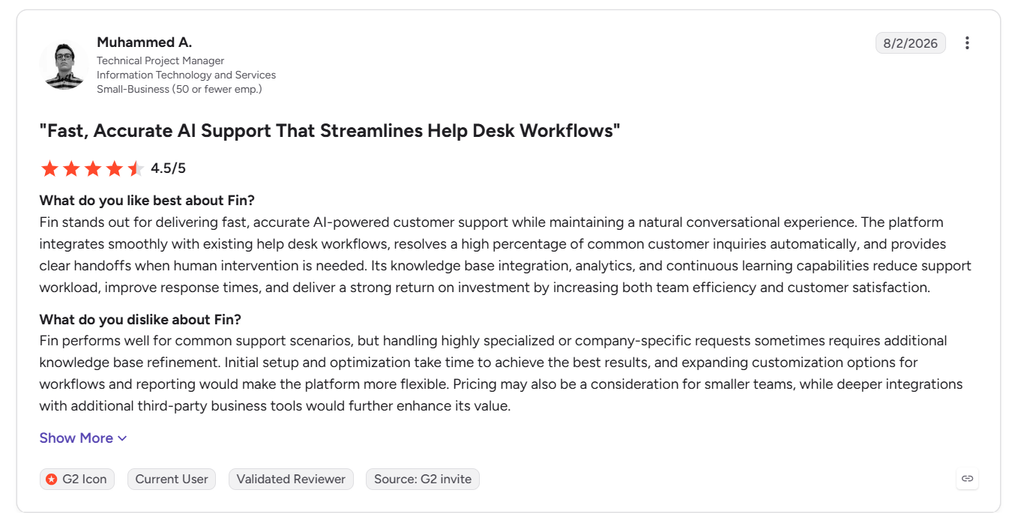
Fin provides AI-powered insights and topic trends as well, but the deeper analytics, AI Topics, CX Scoring, Monitors, and Custom AI Scorecards, sit behind the higher-priced Pro add-on, and G2 and Trustpilot reviewers commonly flag this gating as a frustration once a team wants more than surface-level reporting.
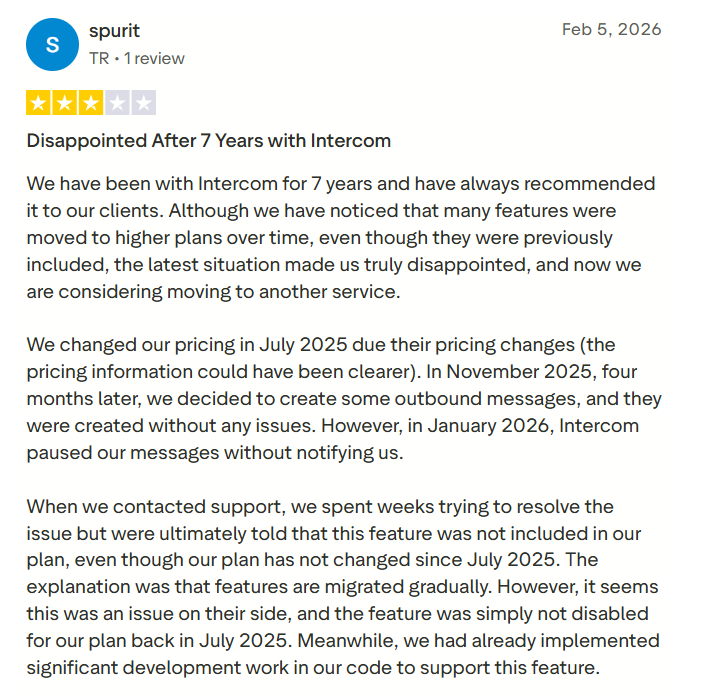
4. Pricing Model
Helpshift prices custom, per-issue, scaled to a studio’s actual volume, quoted directly instead of assembling from a public rate card.
Intercom (Fin) layers two costs. Seat plans run roughly $29 to $132 per seat per month on an annual billing cycle (Essential, Advanced, Expert), and Fin’s AI agent adds $0.99 per resolved outcome (a resolution, procedure handoff, or disqualification), with a 50-outcome monthly minimum and no volume discount.
That model is transparent at low volume, but several pricing breakdowns note the per-outcome fee scales unpredictably once resolution volume climbs into the thousands, which is exactly where a live-service game with a launch or event spike lands.
5. Setup and Support
Helpshift migrations complete in roughly 10 days through Keywords Studios, backed by gaming-specialist human agents for the cases Care AI should not handle alone, plus hypercare support during the first weeks live.
Fin can activate in 1 to 3 days for a team already comfortable with self-serve configuration, which is a genuine speed advantage for a small team. The tradeoff is a generalist support model. There is no gaming-specialist layer, and account setup assumes a standard SaaS or ecommerce support workflow. Intercom doesn’t support player-specific escalation paths like ban appeals or live-ops surges.
When to Choose Helpshift
1. Choose Helpshift if you are scaling fast
A launch or content drop can multiply ticket volume overnight, and Helpshift’s infrastructure and per-issue pricing are built around that spike rather than penalized by it.
2. Choose Helpshift if churn is the priority
Care AI and Helpshift’s Engagement solution are built around player lifetime value, not ticket deflection alone. Studios like Trailmix have reached 93% automation with a 4.3 CSAT score, and Rovio has automated 77% of Angry Birds support conversations.
3. Choose Helpshift if omnichannel means in-game plus Discord plus web, unified
The same platform that resolves an in-game ticket also carries context into Discord and community channels.
4. Choose Helpshift if you need gaming specialists, not generalist agents.
KRAFTON has reported $10.6M in support cost savings by pairing Care AI with Helpshift’s gaming-trained human layer.
When Intercom Might Be Better
1. Intercom (Fin) is a strong choice outside gaming.
For a non-gaming B2B or B2C team, its generalist AI agent, broad integration library, and transparent per-outcome pricing are genuine advantages, and ISO 42001 certification is a real procurement signal in regulated industries.
2. It also wins on pure setup speed at low volume.
A small team with modest, predictable ticket counts can be live in days without a dedicated onboarding engagement, and the $0.99-per-outcome model is easy to forecast below a few hundred resolutions a month.
Teams that need zero hands-on, high-touch support, and are comfortable configuring workflows themselves inside a self-serve tool, may not need the dedicated migration and specialist layer that Helpshift is built around.
Full Comparison: Helpshift vs Intercom (Fin)
| Dimension | Helpshift | Intercom (Fin) |
| Platform type | AI-native player engagement platform | AI agent + helpdesk suite |
| Ownership | Keywords Studios | Rebranded from Intercom, May 2026; Salesforce acquisition signed June 2026, pending close |
| Best for | Gaming studios | General B2B/B2C support teams |
| AI agent | Care AI (gaming-tuned, agentic) | Fin AI Engine (cross-industry, agentic) |
| Reported resolution rate | 70%+ | ~76% average across Fin’s customer base |
| In-game SDK | Yes, native (mobile, PC, web, console) | No |
| Console handoff | Patented QR-code handoff | Not applicable |
| Channels | In-game messaging, web, Discord-native | Chat, email, voice, SMS, Slack, WhatsApp, Discord |
| Languages | 75+ (Language AI) | Multilingual, no gaming-specific tuning |
| Compliance | SOC 2, GDPR, COPPA, ISO 27001, HIPAA | SOC 2 Type II, ISO 27001/27018/27701/42001, HIPAA, GDPR |
| Pricing model | Custom, per-issue | Seats ($29–$132/mo) + $0.99 per resolution outcome |
| Setup timeline | ~10 days, with hypercare | 1–3 days self-serve |
Ready to Choose Your Player Engagement Platform?
The decision usually comes down to the question of whether your support volume comes from players or from customers in general. Intercom (Fin) is a mature, well-certified AI agent built for support across every industry. Helpshift is built specifically for the tickets that actually drive player churn and LTV, delivered natively inside the game, with gaming-specialist humans backing up Care AI when a case needs judgment instead of automation.
If your studio is scaling fast, fighting churn, or running support across in-game, Discord, and web as one experience, Helpshift is built for exactly that. See how Helpshift compares for your studio or check current pricing.
Frequently Asked Questions
1. Does Intercom offer in-game support?
No. Intercom (Fin) supports chat, email, voice, SMS, Slack, WhatsApp, and Discord, but it does not have a native in-game SDK. A game studio using Fin routes players out to a support surface outside the game rather than resolving issues inside the session.
2. Is Helpshift a good alternative to Intercom for gaming studios?
Yes, and it is the gaming-specific alternative rather than a generalist one. Where Intercom (Fin) is built for support across every industry, Helpshift is trained on gaming-specific intents like ban appeals, entitlement sync, and missing rewards, and it ships with the in-game SDK and console handoff Fin does not have.
3. Is there a free alternative to Intercom for player support?
Not at meaningful scale. Fin offers a short free trial rather than a permanent free tier, and its $0.99-per-outcome pricing starts immediately after that. Helpshift is custom quoted rather than free. For a studio evaluating cost, the more useful comparison is total cost per resolved issue at your actual volume, not which platform has a free label.
4. How much can studios save switching from Intercom to Helpshift?
It depends on ticket volume and mix, but Helpshift customers have reported significant savings from consolidating AI, human specialists, and in-game delivery onto one platform. KRAFTON, for example, has reported $10.6M in support cost savings after adopting Helpshift.
5. Can Intercom scale to millions of concurrent players?
Fin’s seat-plus-per-outcome model can technically scale to high volume, but the cost scales linearly with resolutions and has no volume discount, so the bill grows in direct proportion to a launch-day spike. Helpshift’s infrastructure and per-issue pricing are built around gaming’s spike-and-trough traffic pattern from the start.
6. Which platform reduces player churn more effectively?
Helpshift is purpose-built for this. Care AI resolves the friction events, missing rewards, failed purchases, and account recovery that most directly predict churn, and Helpshift’s Engagement solution layers proactive outreach on top. Fin is a strong general resolution engine but is not tuned to gaming-specific churn signals.
7. Does Helpshift work outside of gaming?
Helpshift is gaming-first and built around player workflows, though it also serves mobile-first, player-driven consumer brands with similar support patterns.
8. How long does it take to set up Helpshift versus Intercom?
Fin can activate in 1 to 3 days for a team doing self-serve configuration. Helpshift migrations, including from Intercom or Zendesk, typically complete in about 10 days through Keywords Studios, with hypercare support during the first weeks live to tune knowledge and procedures.