




Player support in gaming is no longer a back-office function you deal with after the fact. A design glitch at 8 PM when your live event kicks off, a payment error at 3 AM in APAC, or a flurry of abuse reports hitting your community chat are front-line emergencies. When your support stack can’t keep up, you lose tickets, trust, revenue, and retention.
One studio found that with traditional email-based support and disparate tools, tickets took upwards of 80 hours to resolve during major spikes. Let that sink in: in a game where players make decisions in minutes, you’re answering in days. The real opponent here is the legacy systems and fragmented workflows strapped to manual triage and patchwork tools.
In this blog we’ll explore how modern gaming studios combine AI and human agents to defeat these legacy bottlenecks, scale support intelligently, and keep the player experience seamless.
The Evolving Landscape of Player Support in Gaming
Support workflows rooted in decades-old systems are under siege. Here’s why it looks different today:
Support has shifted from reactive to real-time
Legacy support models treated tickets like slow lanes: players submitted, queued, waited. In live-ops games today, any delay is a churn risk. Players expect answers as they play and email forms, handcrafted spreadsheets, and siloed teams simply can’t absorb the volume and speed.
AI is becoming central to modern game support systems
When you’re firefighting thousands of similar tickets, human agents hit saturation. AI handles recognition of intent, auto-responds to standard issues, and routes cases, so your team isn’t drowning in noise. Meanwhile you preserve agent time for what actually matters. Across Helpshift gaming customers, automation now handles about 85% of support interactions on average, with 58% of player issues fully resolved end-to-end by automation alone.
Importance of preserving the human touch
Automation handles scale, but players still demand empathy. When a bug wipes out their progress, or they’re banned unjustly, a generic bot answer won’t cut it. Human agents deliver the nuance, connection and trust that keep players loyal. The winning support model recognises that humans and AI are complementary.
The Case for AI in Player Support

Modern studios adopt automation for one simple reason: it stabilises operations. Here’s how:
Speed and 24/7 availability players expect
Players access games on the couch, on the subway, globally around the clock. If support closes at 10 PM local time, it’s too late. AI-powered chatbots embedded in-game keep help live at all hours. They prevent tickets from stacking when you’re logged-off hours.
Automating high-volume, repetitive queries
Every support lead knows the granularity: 60% of tickets are repeat issues with known resolutions. Bots tackle login resets, device mismatches, reward explanations. That deduction frees your team from triage and leaves them to resolve the edge-cases.
Personalisation at scale through data and context
Not all bots feel robotic. When AI has access to player history, game state, device data, you can deliver responses like: “I see you just hit Stage 45 and picked up the golden sword, here’s how to fix the glitch you ran into.” That context elevates automation to relevance without breaking morale.
Multilingual AI for global player bases
Global studios face a serious problem: language fragmentation. Hiring and training agents for 20+ languages is expensive and slow. Here, you should let AI take the load. AI translation handles instant replies in a player’s native language, and agents respond in theirs.
The Case for Human Agents
Automation handles the defaults. Human agents handle the vital exceptions.
Building emotional connection and trust with players
Scaling is important but a missed nuance can cost you. When a VIP loses data or a player’s first-purchase fails and there’s fear of charge-back, the human moment matters. That personal touch shifts frustration into advocacy.
Handling complex or sensitive scenarios
Bans, fraud, progress loss, toxicity, refunds, these are not rote. They require judgment, escalation, sometimes multiple systems. Bots may triage, but humans close the loop.
Providing context-driven insights back to development teams
Human agents are also your live-ops sensors. When many players report a crash within 10 minutes of an update, agents pick it up and route the trend back to the dev team. That intelligence loop is lost if you automate everything.
Finding the Right Balance Between AI and Human Support
When to automate and when not to
Automate when you see predictable flows (account reset, lost reward, basic FAQ). Engage humans when you see variation, ambiguity, or emotional stakes (VIP, refund, ban appeal). Map your player journeys and mark these zones.
Designing seamless bot-to-agent handoffs
Poor handoffs destroy the experience. If a bot says “How can I help?” and the player ends up repeating everything to a human, you’ve done more damage than the original ticket. Ensure context is passed, variables kept, attachments intact.
Using AI to empower, not replace, human agents
Smart routing reduces bottlenecks. AI should surface the right case, pull the right context, suggest possible solutions then the agent chooses. Agents work faster, feel supported, and deliver higher quality.
Creating feedback loops between bots and humans
AI models stale if left unchecked. Agents must review escalations, tag missed intents, feed back into automation logic. Over time your system gets smarter but only if you build the process.
Helpshift’s Approach to Blended AI + Human Support
Here’s how Helpshift transforms the strategy into operational reality.
AI chatbots for instant player resolutions

Helpshift’s bots live inside your game via in-app messaging. They address common player issues, respond instantly, and reduce interruptions to gameplay. And because they work 24/7, you’re covered across time zones without hiring 24/7 staff.
Smart routing to ensure human agents handle high-value cases
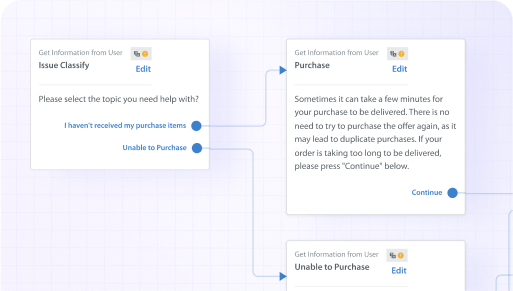
Helping studios cut assignment delays matters. Helpshift’s AI routing uses player context (loyalty tier, payment history, issue type) and directs tickets to the right queue—so high-value players and complex cases land with humans fast, and low-value queries stay automated.
Real-time translation and context for human agents

When a player in Brazil writes in Portuguese, the agent sees a translated version in English with full context like device, game state, history. That means you don’t need 20 regional teams. You support global players with a local feel.
Unified dashboards for AI + agent collaboration
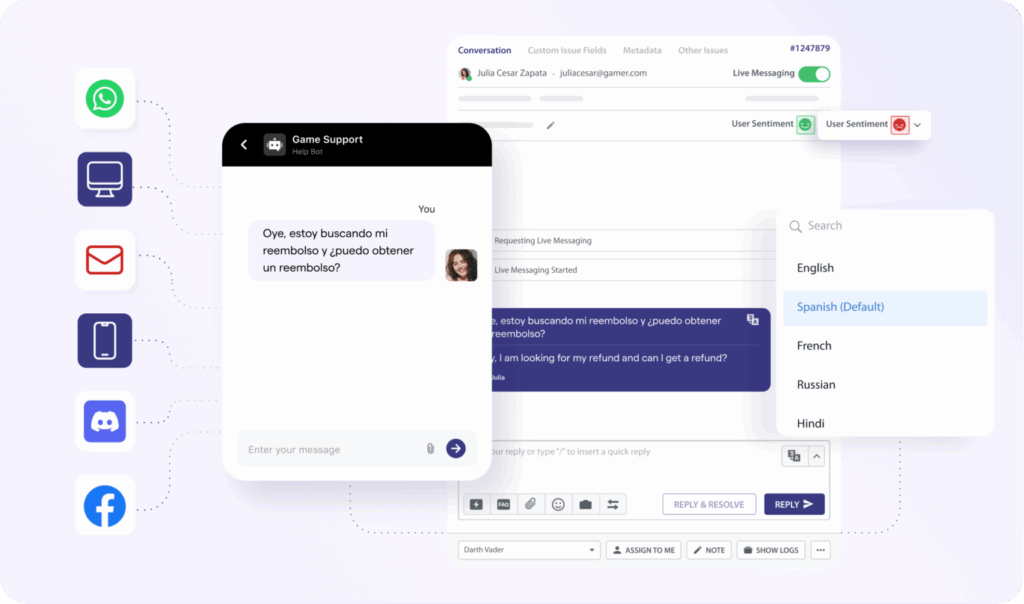
Helpshift gives you a single workspace: bots + human conversations, ticket queues, analytics. You get visibility into where handoffs happen, why escalations went through, and where bots should improve. That lets you master the balance.
Case Studies: Studios That Have Found the Right Mix
Here are three real-world examples of studios who turned towards automation and saw great results:
Bytro Labs – Managing 17,000 monthly tickets with a lean team
Bytro Labs operates 12-language titles with 15 million players and handles 17,000 tickets per month with just 2.5 agents. They achieved 99% automation rate in their contact-centre stack in just 20 days. With Helpshift they replaced chaos with in-game workflows and self-service as the first line of defence. Result: agents focused on the few complex cases, while automation handled the rest.
AIDIS (Critter Crew) – Global self-service at scale
AIDIS launched its match-3 title across 123 regions and 9 languages. With Helpshift they hit 90% FAQ deflection, achieved 96% automation, and logged 93% of issues via in-app SDK. Their CSAT reached 4.5. The antagonistic legacy? Manual support, multi-language chaos, and cost blow-outs. They moved fast (1–1.5 months rollout) and freed human agents to handle only where it genuinely counted.
SYBO (Subway Surfers) – High volume, high precision
SYBO Games supports a user base of over 150 million monthly players. By switching to Helpshift they saw a 86% reduction in time to first response (1 h 40 m), a 95% ticket deflection rate, an 80% boost in agent productivity, and a CSAT of 4.3 from a previous 3.8. Legacy tools here slowed everything: email forms, outdated bots, siloed queues. Once they adopted unified in-game chat + AI routing + human escalation, they could keep pace.
Best Practices for Hybrid Support Models
Here are tactical moves you can start this week to build your own balanced model.
Map out player journeys to identify automation opportunities
Plot every key moment: login, purchase, event launch, bug report, ban appeal. Identify where players hit friction and where patterns repeat. That visibility shows you where automation pays off and where human presence remains essential.
Train agents to work seamlessly with AI tools
Your agents should see bots as teammates, not competition. Provide context, enable suggested responses, feed bots with agent learnings, and reward agents for quality of escalated work (not just volume). That builds agency and trust.
Track CSAT, FRT, and deflection to measure the impact
Focus your dashboards on:
- CSAT – how happy are players post-interaction?
- First Response Time (FRT) – how quickly do you answer?
- Deflection Rate – what percentage of issues are resolved without a human agent?
Final Thoughts: Human Empathy, AI Efficiency
Your next support milestone shouldn’t be “AI vs Human” but “AI and Human.” The enemies aren’t the bots or the agents, it’s the outdated inboxes, the manual spreadsheets, the laggy handoffs, the global language gaps. When you build a support system where AI handles what it should and humans step in where they must, you create a support experience as smooth as the game itself.Let Helpshift be the bridge that gives you that balance. Request helpshift demo.