




Mobile games are designed to feel immediate. A player taps to enter a world, completes a run, upgrades a character, or checks timers in a spare minute. The experience is fluid and lightweight. But when something goes wrong and the player has to leave the game to find help, the flow breaks. And for many players, that break is enough to end the session.
A recent Helpshift benchmark found that more than half of mobile players who experience friction during early sessions don’t return after the interruption. It isn’t frustration alone that drives this drop. It’s the shift from play to problem-solving. Support must happen where play happens, or it risks disconnecting the player from the moment that matters.
This article explores why hyper-casual and mid-core audiences especially depend on support that feels native to the device and the game environment, and how mobile-first support helps studios maintain momentum, loyalty, and player comfort.
The Mobile-First Reality of Today’s Gaming Landscape
Mobile isn’t just a platform option anymore. It’s where most play originates, grows, and returns. Understanding player rhythm is key to understanding why support needs to move with that rhythm:
Why mobile is the primary gaming platform globally
Mobile games fit into everyday life. The device is already in a player’s hand. There’s no setup. There’s no session commitment. The convenience itself is the engagement loop. This is why mobile-first design affects everything from UI to support experience.
How player behavior flows through mobile, console, and PC
Long-form play on PC and console tends to involve settled posture and focused time. Mobile play happens in transitions: while waiting, commuting, or unwinding. When a question arises, help needs to be just as lightweight as the moment itself.
The rise of hyper-casual and mid-core games and their support needs
Hyper-casual games thrive on simplicity and quick decision loops. Mid-core games build deeper systems, goals, and identity. These are different playstyles, but they share one truth: support must stay inside the experience or risk pulling the player away from it.
The Hidden Friction: Legacy Support Workflows in a Mobile World
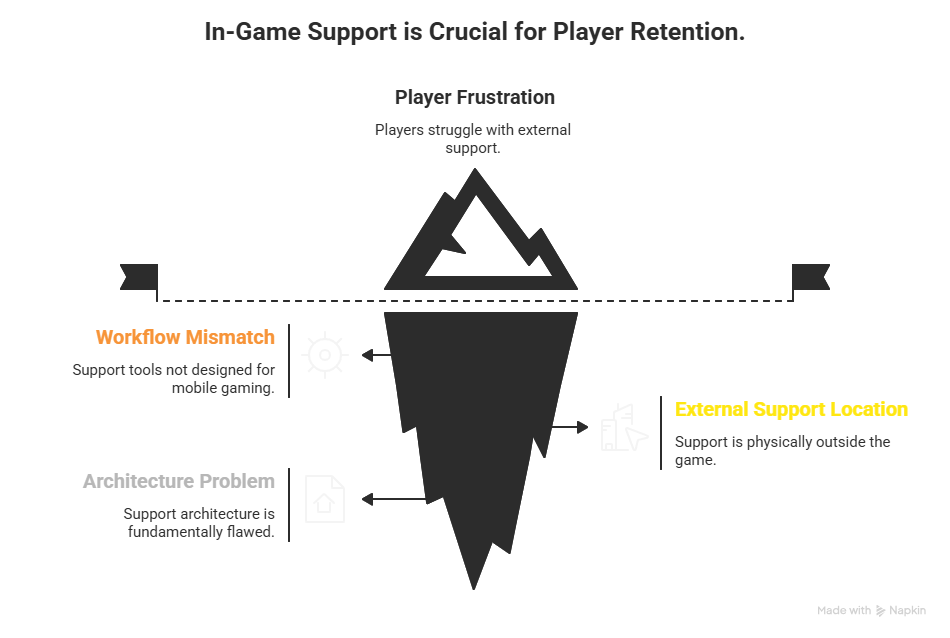
Mobile gaming grew fast. Support systems did not grow with it. Many studios still rely on tools originally shaped for web or PC support environments such as email threads, support portals outside the app, and community channels that double as troubleshooting forums.
These workflows weren’t designed for tap-based play, rapid loops, or players who move in and out of sessions quickly. A player who is asked to search for help, switch apps, or write a detailed ticket has to step out of the moment. And once momentum fades, re-entering the game feels harder.
This is not about outdated software. It’s about support being physically located outside the experience players are engaged in.
What this looks like on the ground
- Players ask for help in reviews because it feels quicker
- Backlogs spike whenever Live Ops events roll out
- Agents answer the same clarifying questions repeatedly because screenshots are hard to gather when support is external
- Players quietly churn without ever reporting the issue
The challenge isn’t motivation or effort. It’s architecture. Support must sit where the experience lives.
Understanding the Support Needs of Hyper-Casual vs. Mid-Core Players

The audiences differ, but their emotional relationship to support has a common thread: support should keep the play session intact.
Hyper-casual players: fast-moving and momentum-driven
These players often try a game without attachment. If they hit friction, returning requires intent they may not have decided to invest.
Mid-core players: invested time, progress, and identity
Progression, gear, and achievements matter deeply. A delay in resolving an issue feels personal, not procedural.
Why both groups respond well to embedded, real-time support
When support appears as part of the experience, players don’t feel like they’ve stopped playing. They feel like they are simply continuing the journey with guidance.
7 Reasons Mobile-First Support Helps Maintain Game Flow
Mobile-first support complements the natural movement of mobile play. It’s built to respond in the moment a player needs help, without asking them to step away.
- Help appears in the same space where play happens
When support sits inside the game, the player doesn’t have to pause their experience or remember to seek help elsewhere later. It feels like a continuation of the same journey, not a separate task. This keeps the emotional connection to the game intact. - Fast guidance matches short session lengths
Mobile play often happens in brief windows of time, so support needs to respond in that same rhythm. Quick guidance helps the player continue without losing their place or intent. Even a small delay can feel like momentum slipping. - Visual and interaction consistency reduces cognitive load
When the support interface shares the same design logic as the game, players don’t have to re-learn how to interact. Familiar touch interactions, layout, and tone reinforce comfort. This allows the player to stay focused on solving the issue rather than navigating a system. - Automation stabilizes support volume
Automated workflows take on routine questions, freeing agents to handle moments that require care or clarity. This means the support experience remains steady even when player activity spikes. Stability benefits both players and the team behind the scenes. - Multilingual support increases comfort across global audiences
Players communicate more naturally when they can express themselves in their preferred language. Real-time translation keeps conversations clear and reduces misunderstandings. The result is a support experience that feels welcoming, not effortful. - Support conversations reveal where friction forms
The questions players ask often highlight where instructions, pacing, or UI moments can improve. These insights help teams refine onboarding, balance mechanics, and smooth progression points. Support becomes an ongoing feedback channel that informs design. - Responsive support strengthens the player’s emotional connection
Being heard and helped in the moment can restore trust and confidence in the game. It signals that the studio cares about the player’s experience, not just the playtime. This feeling often translates into ongoing engagement and willingness to return.
How Helpshift Enables Mobile-First Support at Scale
Helpshift was built for in-app support environments, making assistance feel like a natural part of the play experience not an interruption.
In-app messaging that stays within the game
Players can reach out for help through Messaging, which opens an in-game conversation panel that matches the look and feel of the title. This keeps the player inside the session, maintaining continuity instead of asking them to switch apps or channels. The conversation becomes another part of the game environment rather than a detour.
AI chatbots for timely guidance
Many questions like progress clarifications, reward timing, or basic troubleshooting can be handled by AI and Automation. These guided flows help players resolve common issues quickly and route more complex needs to agents with the right context. This steadies support volume and preserves response quality during busy event windows.
Multilingual support that respects the player’s voice
When players can communicate in the language they’re most comfortable with, they explain concerns more clearly and confidently. The Help Center supports localized FAQs and resources, while in-message translation helps keep conversations smooth across regions and time zones. This builds trust and reduces friction for global audiences.
Analytics that inform Live Ops and game design
Support interactions often surface where players hesitate, get stuck, or misunderstand game systems. With the Agent Workspace, teams can view conversation patterns, spot recurring friction points, and feed insights back into onboarding, balancing, or event design. Support becomes a continuous learning channel that strengthens Live Ops decision-making.
Case Studies: Mobile-First Support in Action
Studios implementing in-app support often see not only smoother operations, but stronger continuity in the player experience.
Hothead Games
Hothead supports millions of monthly players across multiple mobile titles. Before in-app workflows, it was harder to interpret player issues in context. With Helpshift, they introduced guided flows and messaging that helped streamline repetitive inquiries and maintain responsiveness even during concurrency spikes.
Halfbrick
Halfbrick titles like Fruit Ninja and Jetpack Joyride attract a global audience with varied play habits. Helpshift allowed them to offer support that felt native to the game environment, with players able to send screenshots and short clips from within the session. This improved clarity and reduced ticket back-and-forth.
Zynga
Zynga manages player relationships across regions and time zones. Helpshift’s centralized support operations, combined with automated routing, enabled Zynga to coordinate consistent care across large player populations without proportionally scaling agent teams.
Key Metrics That Show the Impact
When support aligns with how players play, operational stability and player comfort become easier to sustain.
- First Response Time: In-app workflows acknowledge players immediately with guided paths.
- Ticket Volume Balance: Automation reduces repeat inquiries and sharp surges.
- CSAT & Retention: Players tend to stay when they feel guided inside the journey they chose.
Final Thoughts: Support Where Play Already Lives
Mobile games are made to be picked up easily and enjoyed fluidly. Support that respects that rhythm feels less like assistance and more like part of the game’s world. Helpshift equips studios to offer care that fits the environment players already trust right where they are, and right when they need it. If you’d like to see how that looks and feels in-game, schedule a short walkthrough.